Saturday, August 19, 2023

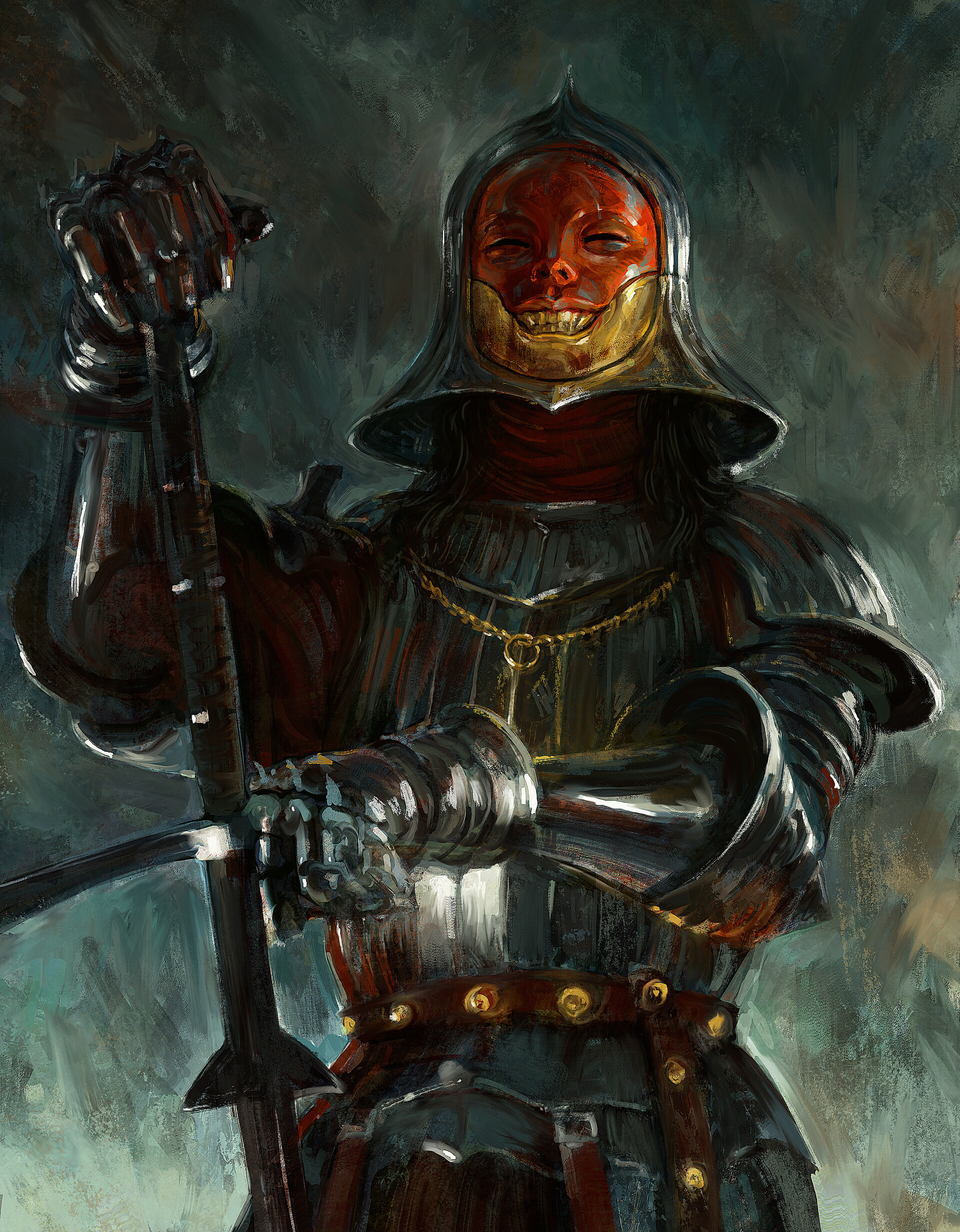
DESERTER (GLOG Minizine)

The DESERTER is one of the most-viewed posts on this blog, ever — an ex-soldier, one who ran away from it all, leaving their life as far behind them as they could get it, a class for Arnold K's Goblin Laws of Gaming. It drew on a few different inspirations, first and foremost that of G. R. Michael's Zouave; it remains among the most popular things I've ever posted, nearly three years on.

I've had thoughts about zines for a while. Self-published, small, DIY — it has a definite appeal, with zines remaining a common enough format for tabletop RPG "content", especially with Kickstarter's annual Zinequest. It's something I'd long wanted to try my hand at, in some fashion or another. A month or so ago (yes, that's how long it's taken me to write this) I decided to give it a go, at long last, using some old work of mine. I trawled through my backlog and landed on the Deserter as a good fit, especially with the original post's inclusion of possible backgrounds. I remembered a format I had seen used before, for SaltyGoo's Cradle of the Gods (a collection of deities), which takes only a single A4 page.

After a few hour's experimentation, playing around with design and layout and content (and some furhter trial and error with cutting and folding), I arrived at what I'm calling the final product, at least for now. Not sure if I'll ever see someone else use it, but I found it an enjoyable and enlightening experience, one that I may yet follow up on.

apologies for the questionable quality

You can find a PDF version here, or a PNG file here. I'm happy to answer any questions or queries, either about the process or about the zine itself; I've no idea, still, if this was the best way to go about it, but I can't pretend I'm not content to finally see some of my work in physical form, even if from a home printer.
 

Monday, May 1, 2023

A Slushpost

a post de slush, in the same vein as many | of  | my | betters. contains material from two notebooks and a few years' worth of conversation. there's more where this came from; perhaps it will see the light of day.

— — — — —

1. Fantastic names for an investigator: Seeker, Eye, Quester, Harbinger, Stalker, Questioner, Hand, Scion, Auditor, Herald, Hound, Gatherer, Watcher, Warden, Justice, Keeper, Assayer,  Winnower, Unveiler 

2. The thing no-one ever tells you about magic is how much it hurts.

3. O, sing the song of Yeruzhen, city most resplendent, city most desolate. Jewel of the Tarr, seat of the Empress; monument of ruin, home of the lost...

4. ALL PRIESTS ARE PROPHETS UNTO THEMSELVES — ONE WORLD FAITH — ONE TRUE LIGHT — MANY VOICES

5. We are Flame — an ephemeral incandescence dancing across this realm and the next, shifting twisting flickering in place and world and time, everlasting essence of light's final moment. 

6. The Ruler, the Maker, the Watcher, the Butcher, the Dreamer — patron of leaders and commanders, of farmers and family, of scholars and sailors, of the bloody and the damned, of thieves and lovers

7. spatharokoubikoularios: an office in the Byzantine court, "sword-chamberlain".

8. Hedge Knights—so named for their choice of steed, the noble hedgehog...

9. skyship flight powered by the secret names of angels, inscribed upon gold blocks. wielding the pieces of the divine machine in this way allows pilots violate the law of gravity.

10. Pigeon • /ˈpɪdʒɪn/ • noun. : a simplified speech used for communication between birds with different languages.

11. A colony ship, bearing a hundred thousand settlers in suspended animation and a still-awake skeleton crew. It veered off course a few centuries ago; culture among the descendants of that original crew diverged, still holding true to "the passage to the Land That Was Promised" and now worshipping "Those Who Slumber", all of their once-knowledge lost to time and superstition.

12. Dreznor stands triumphant, a glorious shambling mess of slums and smog, built atop the mage-blasted ruins of a city now forgotten, lost to the ceaseless churn of time.

13. The masked priests of Our Lady of Immaculate Eternity rise with the sun. They don their vestments, sorrow-black and earthen green, adorn themselves with the jewellery of their station, ring and torc and glittering pendant, and begin their solemn procession through the city of Brenstadt...

14. A Divinity of Clockwork (Jodorowsky, 6:01pm)

15. Wildly differing levels of magical concentration across a setting — aetheric deserts and island pockets of mana, with concentration of magical species, wizard towers, and mysterious ancient artifacts correlated thusly

16. priests with violence on their tongues and prayers on their blades

17. “Through the crimson canyons and desert seas of Mars, there howls an eternal wind. Through its red hills and forgotten canals, it can be heard; it can be seen. In the swirl of dust at the bottom of a crater, in the great storms atop its highest peaks, it is found—the everlasting funeral cry of the long-dead ghosts of a planet bathed in blood.”

18. The Court of Ancient Kings — the Crown Prince's highest council, a parliament of undying souls. Accessed only through the Voice of the Court, a priest of Shanahndrash (maiden of dreams and death), each Prince ascends to its membership upon their death.

19. I awake in darkness. I have always been in the darkness. The darkness has four walls, without windows; its lone door, across from where I lie, stands locked. I have always been in the darkness.

20. A dishevelled god sits slumped on the street corner, an empty cup in front of them, the cardboard sign beside them bearing in bold black marker: “WILL WORK MIRACLES FOR FOOD”

— — — — — 

LOT 41. ATLAS OF ENDLESS EARTHS.

A green leatherbound volume, with its title debossed in gold on the front cover. Authorship unknown, it was recovered from the Library of Babel during an expedition lead by Sir Francis Drake. Its 410 pages contain detailed descriptions of many realms, some of them very close in description to our own world. The means by which many of them might be accessed remain obscure, though the book´s passage from collection to collection speak to the desirability of such a work to any of our Auction's fine guests.

— — — — —

A tradition in a certain nation in Far-Flung Parts is that of the Festival of Bounty. Once each year, as spring approaches and the harsh lord Winter retreats to the north, people of all ages come together in the streets to celebrate, as well as to hope and pray for a great year of harvest ahead. Precise practices differ, with common ones including parades, dances, and parties, though one unifying thread are the masks. Participants don the visage of all sorts of beasts and wild things, from bears to tigers to dragons and more.  In some regions they are relegated solely to children, often crafting their own out of paper-mâché or cardboard, but some claim they hold their roots in a tradition far older.

The Masks of the Maker are ornate vizards that appear to be crafted from wood, albeit without any seams, glue, or carving tools. They perfectly mirror the form of one the Twelve Holy Beasts, as though moulded directly from them. Each is kept isolated deep within the Greatwoods, guarded by ancient guardians and obstacles. While wearing such a True Mask, the bearer possess all of that animal's characteristics, save appearance; they become as heavy, strong, etc. as their bestial counterpart, and gain all of its abilities and senses.

The Twelve Holy Beasts:
1. Bear
2. Hare
3. Crow
4. Eagle
5. Deer
6. Fox
7. Bull
8. Wolf
9. Squirrel
10. Boar
11. Tortoise
12. Lizard 

— — — — — 

and lo, so began our descent;
into that vile dark we went,
t'ward the maw of the beast—
in hunt of the wretched priest

miles and miles the tunnels stretched,
grim markings on the walls etched
though our lamp went low, ne'er did we slow

hours passed in that grim cave
afore we came upon their grave.
there, there i saw that dreadful sight
more foul than any horror of the night
there we found them, sprawled 'cross stone,
their skin as pale as bone
shrouded in raiment grim,
bent crooked in every limb—
this song i name their parting hymn.

— — — — — 

Through the crimson canyons and desert seas of Mars, there howls an eternal wind. Through its red hills and forgotten canals, it can be heard; it can be seen. In the swirl of dust at the bottom of a crater, in the great storms atop its highest peaks, it is found—the everlasting funeral cry of the long-dead ghosts of a planet bathed in blood.

— — — — — 

There I knelt, ‘fore ancient throne
Forehead pressed against the stone.
For the crown’s favour I did vie,
Yet knew as soon I was damned to die;
For it truly is a fickle thing—
The mercy of a merciless king.

— — — — — 

We are a mountain of steam and steel — a profound contraption of chrome-plated cogs and ever-pumping pistons, marching ever-forward. A pilgrim searching for something forgotten, we wander across the desolate landscape, trundling, stumbling, rumbling over hill and mound and barrow.

We are unbreathing; we are unyielding. Through once-great forests, through blasted wastes, through labyrinth streets and abandoned wrecks, we roam.

In the ruins of the future, we find ourself.

We round a corner, pass by an abandoned relic that scrapes the sky, and there we see it. A fragment of untarnished metal among the heap, brightly gleaming under the moon's light, a diamond buried among all the filth in the world.

There, the smallest part of us says. There, comes the call. In moments we are but one in mind and goal, a thousand internal voices shouting in unison, every part of us at once.

There, comes the cry, and we are there, and we are reaching every part of us forwards upwards outwards, opening ourself to this new self and its name and history and truth, outstretching extending widening towards it and we feel it and we know it and we embrace it until it is no longer itself and we are no longer wholly ourself but a union a bond unbreaking until its history its name its truth become ours and once more we are but us: indivisible.

— — — — — 

fin.

Friday, March 17, 2023

A Manuscript Recovered from the Personal Effects of One “Nicholas Fleming” Following His Mysterious Disappearance on the 22nd of March, 1997

Dear                       ,

        The Committee is delighted to confirm the Eiffel Tower as the venue of the Black Auction of 1889 this coming June 21st, extending sincere gratitude to the Académie Républicaine de Philosophie Occulte for their assistance in this matter. Constructed as the centerpiece of this year's World’s Fair and located along the crossroads of over a dozen leylines, the Tower provides a stellar view of the Parisian skyline. Accommodation in the surrounding areas should prove plentiful; we request that any attendees struggling with such make contact with the Committee through the usual channels.

        The Auction proper will begin at midnight, however the Committee strongly encourages guests to arrive some time in advance, both to acquaint themselves with the City of Lights and to properly prepare themselves for the night's proceedings. The Exhibition occupies much of the area surrounding the Tower and is home to a great many entertainments, including a number of displays that may be of a particular interest to attendees of the Auction. Following the formal luncheon at midday on the 20th, time has been set aside for relaxation and sight-seeing—local guides are available on request for those interested in visiting such sites as the Musée de Louvre or Napoleon’s sarcophagus, touring the Seine, or of course taking in the city's famed catacombs.

        Catering for the duration of the event will be provided by the brilliant Mamadou Saganogo, head chef to the imperial household of the Kong Empire in Western Africa prior to the nation's unfortunate collapse this recent year. Any guests with particular dietary requirements are urged to inform the Committee in advance, or make alternative arrangements. At 7p.m. on the evening of the 20th, a private performance by the celebrated Opéra-Comique has been arranged in the Théâtre de la Ville on Place du Châtelet, followed by another meal prepared by Mr. Sagonogo. After dinner, we advise attendees to use the remaining time before the Auction to suitably prepare themselves for the proceedings; space will be made available for any seeking to commune with a Higher Influence for protection or guidance. The Committee will of course go to every measure to ensure the needs of all guests are met, however must ask that participants provide any necessary instruments for such rituals themselves where possible.

        As always, the Committee is pleased to welcome attendees from all across the globe, including for the first time the esteemed Nassereddin Shah, ruler of the Qajar Emirate of Persia, renowned inventor Nikola Tesla, and acclaimed artist Antoni Gaudí. We are also deeply gratified to announce the return of the distinguished Comte de Saint-Germain, as well as his donation of multiple artifacts from his personal collection to this year’s Auction. A delegation from the Grand Orient de France will also be making an appearance, for the first time since London; we thank them for their orchestration of the Taxil affair and its immense success.

        
The Auction will starts at the stroke of midnight. Neither weapons nor personal grudges are allowed in the Auction room. Any guests not present in the room at that time will be refused entry; the Committee’s security for the evening will not hesitate to bar late entrants. We kindly ask that any individuals not affiliated with the Auction seen attempting to gain access are reported in due haste—we make particular note of Mr. Edison.

        The Committee trusts that you await the Auction eagerly, and looks forward to welcoming you to the Tower on the solstice. Within is enclosed a partial catalogue of items for sale this year; we of course cannot guarantee the continued availability of all entries, but encourage attendees to sift through it in advance.

Yours in Confidence,
    The Black Auction Committee
    February 27th, 1889

--------------------------------------------------------------------------------------------------------------------

LOT 1. EL REY CON TÚNICA AMARILLA.

The fifteenth entry in Francisco Goya's famed Black Paintings, originally painted directly onto the wall of his isolated country home. Created in the artist's final years, it depicts a lone figure on a black background, garbed in a golden-yellow vestment with a crown atop their head. Their face lies shrouded in shadow, and across the robe is painted a shifting sea of spiral-like symbols. Viewing is unfortunately unavailable prior to purchase.

LOT 3. EGYPTIAN BURIAL JARS.

Five in number, a set of genuine sealed canopic jars recovered from a tomb near the Valley of Kings by enterprising locals. In addition to the traditional four ceramics—containing the lungs, stomach, liver, and intestines, each adorned with a son of Horus—a fifth one is present, found placed in a separate chest at the centre of the burial chamber. The Committee's cryptoarchaeologists have thus far failed to identify the creature on the urn's lid with any known deity of the region, nor any extant manner of animal. All surviving members of the discovery party have refused interview.

LOT 9. YANGTZE MUD.

A jar of clay recovered from the source valley of the 長江 in the Tibetan Plateau, granted as a gift to visiting European dignitaries by the Guangxu Emperor in 1876, discarded and thought lost until its recovery in a street market in Shanghai. Bears restorative properties, capable of mending rifts and healing ailments, in addition to making any contract sealed with it binding before heaven.

LOT 12. MAGNI OPERIS PRINCIPIA MATHEMATICA (ANNOTATED).

The lesser-known counterpart to the First Principia, the Magni Operis is a comprehensive collection of Isaac Newton’s notes and findings on the Great Work; only a handful of copies from its lone printing survive, the rest destroyed. This lot, in particular, was previously the personal copy of the preeminent Comte de Saint-Germaine, bearing in many places his personal commentary. Contains such secrets as the transmutation of lead into gold, the crafting of divine ambrosia, and the secrets by which one might transcend the laws of equivalent exchange.

LOT 17. MAP TO CHRIST'S TOMB.

Directions to the true location of Christ's body, located in a cave on Pech-le-Cardou in the south of France. Contains, additionally, the necessary instructions to reveal the tomb entrance, as well as the charms required to Witness the Lord's corpse and survive. Independently authenticated by Auction experts; veracity guaranteed.

LOT 26. TAROT READING.

An individual session with an avowed Master of the Etteillan tradition, who wishes not to be named. They have offered a single personal reading, with accuracy assured; they claim to be capable of Sight both past and future, having previously predicted and claimed responsibility for Napoleon Bonaparte's rise to power, the Haitian Revolution, and the selection of Leo XIII (who once again graces our patrons this year) to the papacy. In the event of customer dissatisfaction, the Committee accepts no liability.

LOT 34. POLAR SPICE.

First recovered and sampled by the doomed crew of the HMS Bravery, of whom only two members returned, a seasoning sourced from the bottom of a crevasse near the Antarctic Great Ice Shelf. Its taste is pliable—resembling that which the collective agrees it to be, or simply that which its consumer craves most—and capable of replicating non-gustatory sensation, including feelings of despair, disgust, and awe. Incurs mild-to-middling hallucination (depending on quantity ingested) and promotes mental openness, having demonstrated great success in attempted communion with certain Higher Powers.

LOT 51. TARTARIAN DIADEM.

The royal crown of Tartary, the antediluvian civilisation responsible for the construction of many now-lost wonders, including the Tower of Babel. Silver-coloured and bearing a metallic sheen, it is encrusted with a variety of gems, including most notably a large septagonal topaz above the forehead. It demands a toll of its wearer—often resulting in severe exhaustion, dehydration, and fainting, with numerous recorded deaths—yet in return grants the monarch complete and utter authority over those around them.

LOT 39. HUMAN SOUL.

A captured soul, free of tangible form. Isolated by Doctor Victoire Fischer, real-world basis of Mary Shelley's The Modern Prometheus, through a thanergetic experiment that remains obscure. Authenticity assured—guaranteed suitable for ritual, barter, or imbuing into corporeal form.

LOT 45. HORN OF UNICORN.

The horn of an extinct Northern European unicorn, obtained by a member of the Old Hermetic Lodge from the traditional grounds of the Wild Hunt. Purported to act as a panacea of remarkable strength, it bears prominent place in the alchemical mythologies of Hermes Trismegistus. Wholly intact and preserved in pristine condition, it further carries great symbolic power and an intense international notoriety. Currently one-of-a-kind outside of private collections.

LOT 53. ROD OF MOSES (IMMORTAL SNAKE).

An ageless serpent, once the staff of the Abrahamic prophet Moshe, now transformed permanently into their current ophidian form. Previously held in Solomon's Temple, then Constantinople, now offering its services on the private market, it proffers an accurate rendition of Biblical truth, in addition to comprehensive knowledge and understanding of more than 460 assorted mystical traditions. Note that this is not an offer of ownership, but instead of a professional arrangement.

LOT 70. ERASURE.

Expulsion of a single individual from the akashic record. Evidence or memories of their existence will vanish or be dismissed. Those in the future shall be incapable of remembering them afterwards. Usable either on the self or upon an enemy of one's choosing.

Monday, February 6, 2023

1d30 Trinkets and Oddities for Adventurers of All Sizes

A trove of trinkets, an assortment of oddities, a bevy of baubles, a cache of curios. All ideas free to a good home—appropriate for an interesting additionial starting item, a peculiar prize stolen or won, rounding out a vendor's wares, or whatever other purpose one might see fit.


Mateusz Wiśniewski
  1. A coin of the highest local denomination, with two heads.
  2. A full-sized trombone, nonetheless able to fit into any pocket or container.
  3. A frog, able to record and repeat messages up to one sentence in length; can only hold one at a time.
  4. A jar, containing a very annoyed bat, refilled at any reputable swooprat breeder.
  5. A double-ended flask—any liquid poured out one side comes out perfectly chilled, out the other scalding hot.
  6. A pair of leather boots that make not a sound.
  7. A dead snake, ~10 yards in length (works surprisingly well as a rope).
  8. A startlingly convincing mask of the local mayor's (or other city official) face.
  9. A taxidermy model of a small animal that probably doesn't exist.
  10. A pair of dice enchanted to only ever land on 1 or 6.
  11. A small hand drum that plays itself to match the beat of music around it.
  12. A bottle of perfume that smells like its wearer's favourite scent, cranked up to 11.
  13. A questionably authentic letter of authority from the local duke, painfully vague in what it permits.
  14. A pocket mirror.
  15. A music box, containing a famous hymn. Painfully loud.
  16. A stolen satchel, bearing the official seal of the Courier's Guild.
  17. A pack of gold-leaf playing cards, including jokers, blanks, and a double-back card.
  18. A gold medal, its inscription long worn off.
  19. A deeply heretical prayer book, proscribed in all lands of the Church.
  20. An expensive locket, containing nothing but a daguerreotype of a frog.
  21. An adjustable wrench, caked in rust.
  22. A hat, always just a bit too large for any bearer.
  23. A hot air balloon license, with the PC's name spelled slightly wrong.
  24. A set of wind chimes that generate a small breeze when rung (warning label—"keep out of wind.")
  25. A diary that writes about its owner's day by itself.
  26. A clockwork mouse—makes noise, can travel ~10 yards before stopping, and must be wound before use.
  27. An address book of folk-healers and local wise ones.
  28. A wanted poster, depicting someone who looks just like you.
  29. A pickled pinky finger, supposedly that of a famed saint.
  30. A pair of glasses that don't improve the bearer's distance vision, but instead let them see regardless of conditions.

Sunday, January 8, 2023

The Isle of Inishbradden

FIVE CENTURIES AGO, the Mists descended on Inishbradden for the first time; a cloak of ghostly grey, bathing the island in nightly luminescence. It appears each night in perfect time with the rising of the moon; few now dare enter its cold embrace, for fear of foul magic and the fae of folklore.

FIVE DECADES AGO, the current Countess of Ember ascended to the island's seat of power, her laws harsh and temper harsher. Never since has she appeared in public without her mask of iron, her work done only through ambassadors and intercessors.

FIVE YEARS AGO, ships stopped coming from the Mainland. Never a bustling trading post, the Isle is now cut off entirely from contact with the world beyond, with no sign of resupply from off the island in sight. No longer does the Crown seem to maintain any interest in keeping the Isle under its domain; not a single expedition from the island has returned since.

FIVE DAYS AGO, reports came from farms to the north of the mysterious disappearance of an entire village. Not a soul remains, animal or human—and the Countess's Guard are far from eager to investigate.

FIVE MINUTES AGO,
you were roused from your slumber on the bare stone floor of your cell, and given an ultimatum: death, or freedom, in return for service rendered. The latter means trekking out into the Mist, to discover what really happened to that village

⁂

image by me

⁂

Each night on Inishbradden, every door on the Isle is bolted, every window firmly shuttered, people of every age safely indoors. With the moon comes the Mist, and with the mist creatures fit for no mortal eyes. Every family on the Isle claims heritage lasting centuries; as far as anyone remembers, the Countess's family has always ruled.

You are a prisoner. You violated the law of the land, and for it you pay the price; it seems that that price might well be greater than you ever imagined. You don't have a choice. You've got to do it, and pray to the Bladed Lord you'll make it through.

⁂

Black Alchemist:
You worked outside the law, operating without license and with secrecy assured. One of your clients ratted you out; you've had plenty of time to think about who it was.
Start with:
a roll of bandage fashioned from an old gaol uniform, a small pouch of salt, iron, and blessed ashes
Perk: with a minute's close inspection, you have a 4-in-6 chance of correctly identifying any plant or mysterious substance. with ten, it becomes 6-in-6.

Drunkard:
You spent more nights at the pub than you did at home. The Day Watch finally decided to drag you in for nuisancy after some particularly well-placed public urination.
Start with:
a smuggled flask of whiskey, impossible to find on your person unless you allow it
Perk: you have advantage on Saves against ill effects from consuming food or drink

Arsonist:
From an early age, you had a special fondness for starting fires. The Brotherhood of the Hallowed Sword caught you behind one of their chapels; your time in the Guards' custody has been a breeze in comparison.
Start with:
an all-weather fire-starter, a burning desire to take out your anger on your surroundings
Perk: with an hour of preparation and access to suitably flammable materials, you can fashion an explosive device with a fuse of however long you wish

Charlatan:
You made your living running confidence games on the Isle's up-and-coming elites, offering investments and trade opportunities that never made themselves manifest. You defrauded the wrong person, and you've spent the time since plotting how you might escape your confines.
Start with:
a "friend" in any town you visit, a trustworthy smile
Perk: you can affect any accent or demeanour you so desire; proper imitation demands proper study

Pickpocket:
You survived on deft fingers and quick thinking, until one day you couldn't think quite quick enough. You were expecting a severed hand; mist-catching is almost preferable to you.
Start with:
a short piece of metal, fashioned into a miniature blade, a token to remember a loved one by
Perk: you can hide from view on your person anything that would fit in your palm, and you  perform sleight of hand well enough to impress and distract any layperson for a moment

⁂

FIVEs format shamelessly stolen from the pre-eminent Lexi of A Blasted, Crated Land.

Monday, January 2, 2023

a snippet from the city

An excerpt of in-world writing from the setting of the City Who Slumbers Not. The first post provides some useful context.

By Tyler Edlin


“Invisible cults are perhaps the greatest oddity of the Fair City's endless religious movements. While most churches have some purpose to their worship, some powerful being, some idol, they reject this most wholeheartedly, favouring instead a great "Unseen God". Supposedly all-knowing and all-powerful, they revere a deity with no proof of their existence (and yes, most often 'their'). They consider even worship of the City herself to be blasphemy, despite the obvious importance of the urban cults to a functioning society. All individual claims to divinity are rejected; their great leaders are only ever mere 'prophets', interpreting the whispered words of some higher being. Doctrines vary wildly from sect to sect and branch to branch, with different texts and different prophets deemed holy by each. A common thread is the purported existence of some coming saviour, a person to unite all these cults under one banner and bring them out of the shadowed fringes of society; the nature of this saviour is rarely ever agreed upon.

One would wonder how such beliefs persist, especially with their 'omnipotent' god's persistent failures to protect their worshippers from zealots of other stripes.”

 —Onn the Manny Religiones and Belieffes off the Grate City, Tapsfrord Howe, transcribed by Bernard Cowall

Monday, June 13, 2022

Quarter Hour of Writing Challenge: Tattoos

A branch, fallen
The soaring bird.
From dirt, plucked
The mighty bear.
On pyre, burnt
The roaring lion.
Its soot, gathered
The charging bull.
With water, mixed
The wise owl.
Our blade, sharpened
The hunting shark.
Blessed ink, stirred
The leaping hare.
Over skin, drawn
The canny fox.
New scars, made
The howling wolf.
Old tales, remembered.

*    *    *

“The Zarati practice what I regard as a most curious form of glyph-based magic—rather than seeking to inscribe script into objects, or even working it in the air as on Pharron, they choose to carve it into their very flesh, with the use of blades and ink. In contrast to the more outwardly-focused languages of Teragia or Aeregard, Zarati glyphs instead endow effects directly upon their bearer; the granting of new abilities and the enhancement of existing attributes most frequently. Their forms are flowing and spiralling, often working to cover much of the body in the case of those most accomplished. They insist on using only the plane's native ash-leaf to craft their ink, a tree regarded with great reverence in their faith. I have found it a challenge to obtain what little information I have on their Art; the nature of the forms and the associated rituals are matters of much secrecy among their communities.”

—An excerpt from Medarin the Magnificent's Compendium of the Planes, regarding the aetheric Art of the Zarati people of Keora'ana 

*    *    *

As described by Library of Attnam.

Thursday, April 28, 2022

d100 Food Found Foraging in the Bayou


The swamps and bayous of the Ontarachie are ancient—far older than New Alores, older still than any written record. The trees stood when people arrived, and they will stand long after people leave. Layer upon layer of decay and growth and renewal they lie, ever-flourishing on the corpse of the old. On these layers stand the villages of the fungus folk, the Archangel's cathedral, His Resplendent Majesty's great city; all the marvels of artifice made material by mundane hand. New Alores stands resplendent, yet beyond its borders lies something greater—something primal, something verdant. In the Ontarachie, everything is simply more—life abounds, teeming under every surface; its waterways and passages twist and turn, as gnarled and dense and crooked as the branches of any tree; there the lotus truly blooms.

1-10: Mundane mushrooms. On 10, truffles instead.
11-20: Onions. On 20, they're riddled with odd holes.
21-30: Thistles. On 30, they ooze a dark liquid.
31-40: Shrimp. On 40, they're bright blue.
41-50: Rabbit. On 50, it has wings.
51-60: Swooprat (bat). On 60, it bristles with spines.
61-70: Pitch-dark pecans. On 70, sickly-sweet walnuts instead.
71-75: Crawfish. Just crawfish.
76-80: Frog. On 80, it glows.
81-85: Small elk. On 85, it has a crab-like shell.
86-90: Catfish. On 90, it has horns.
91-95: Slugs or snails. On 95, they continue to squirm on the way down.
96-99: Wild pig. On 99, it's coated in spores.
100: Reroll. That, but giant.

An Eralou-related post. Expect more... eventually, perhaps.

Sunday, March 27, 2022

13 Superstitions for Sci-Fi Space-Farers

.

Sailors are notoriously superstitious; does it not stand to reason that the same would be true for those who sail the stars? Here's 13 folk beliefs among the travellers of wildspace, from the crews of the greatest star-galleons to the smallest dragonships, free to a good home.

1. Always take a leak before you launch.
2. Every ship should have a cat, and every crew should trust their cat.
3. Nep'Thulir, the Great Wurm Who Roams the Sea of Endless Stars.
4. The Gravitas, a famed ghost ship, forever damned to drift on the solar winds.
5. If you don't knock twice on your way out of the airlock, what comes back in won't be you.
6. Make sure any new ships are correctly blessed by a Priest of the Seventh Sun before their maiden voyage. 
7. No praying in the Warp, lest you attract a jump-beast.
8. The Void. A vast emptiness, devoid of a single star, meteor, or speck of dust. None pass through it.
9. Moon-madness; never stay too long in the orbit of a moon without a waystation. Nothing good awaits.
10. Always wake up the machine spirits through shanties, prayers, or music before you fly, lest your equipment fail.
11. Hold your breath while passing through a ship graveyard.
12. Never carry change in your right pocket.
13. Idle minds open the way for thought-feasters.


Saturday, March 19, 2022

The Mists Upon the Moor (Patron: The Fae)

For he comes, the human child,
To the waters and the wild
With a faery, hand in hand,
For the world's more full of weeping than he can understand.
—W.B. Yeats, 'The Stolen Child'

A prince of the Autumn Court, a luchorpán, the Wailing Washerwoman; a denizen of the Otherworld, that half-forgotten realm of mists just beyond the borders of our own, the place below the barrows and beyond the Ironwoods. Inhuman all, with motivations as inscrutable as their nature, the Good Folk live at the fringes of the mortal realm, descendants of those who lost the war for Heaven yet escaped Damnation.

By Jakub Rozalski

Perk: Can see through darkness, and always sense the way to the nearest gateway to the Otherworld.
Drawback: People can tell there's something off about you. Normal mortals are always keen to distrust you.

The boon of your pact looks rightfully not of this world—deeply unnatural colours, just-off proportions, a scent it shouldn't have, &c.

Whether you fell asleep aside a barrow mound, danced too close to the Midsummer bonfire, or followed the fairy light into the heart of the forest, those sworn to one of the Fae are left... changed. The mark you bear takes the form of...
1. Eyelids that close sideways.
2. A forked tongue.
3. Pointed ears.
4. An uncanny stare.
5. Scarlet-red hair.
6. Six fingers on each hand.
7. An unnaturally sing-song voice.
8. A constant sickliness.
9. A permanent, too-wide smile.
10. Each of your eyes is a different, inhuman colour.

Mishaps:
1. 1d6 damage to you.
2. MD only return to your pool on a 1-2 until sunrise.
3. You lose all benefits of your boons for 1d6 rounds.
4. Illusions overtake your mind for 1d6 rounds on a failed save; you see things that aren't there, swiping at nonexistent enemies and dancing to a nonexistent tune.
5. You begin to scream for the next 1d6 rounds; on a 6, so does everyone who can hear you.
6. You lose your voice until you next rest.

Dooms:
1. Your eyes are now white as snow. You cannot keep a secret from those who know your name.
2. Your hair is now white as snow. You cannot disobey those who know your name.
3. Your skin is now white as snow. You feel an overwhelming *itch* to go back to the Otherworld. Home.


Another warlock patron; see this post for context, and either of these for further content. Bits taken from a variety of sources; deus ex parabola's Oberon and Titania most significantly.

STORM HERALD (GLOG Class)

You wield the primal powers of wind and sky, nature's fury shaped by your will. You are a tempest of righteous rage, a swirling storm of steel, adrenaline flowing through your veins like lightning.

A GLOG-ification of a 5e Barbarian subclass; Berserk stolen wholesale from deus ex parabola.

Start with: a medium or heavy weapon of your choice, medium armor, an impressive amount of scars, shredded pecs, an animal-hide cloak, an uncanny sense of coming weather 

A: Berserk, Sheltered from the Storm
B: Raging Storm
C: Whirlwind
D: Furious Storm

Berserk: You possess a pool of rage points, starting with 2 at A and gaining another at each level. You may expend a point at the beginning of combat to receive half damage from all sources for the duration, or when performing a feat of strength to automatically roll a 20. A crack of thunder accompanies each expenditure.

Regain a point whenever you eat a big meal and get a good night's rest, or when you go without food or rest to brood on your many enemies. While your pool is full, make a Save against flying off the handle whenever you face disrespect.

Sheltered from the Storm: Extreme environments have no bearing on you. You move unhindered through harsh weather, suffer not the effects of severe cold, and may breathe underwater. Your claps sound as loud as thunder, and your steps may shake the ground.

Raging Storm: Whenever you enter a rage, the air around you now ignites. You may call down a single lightning strike anywhere you can see, inflicting 1d8 damage to everything adjacent to that spot. Clouds gather overhead, wind begins to howl, nearby doors and windows slam open. The storm continues to rage as long as you do.

Whirlwind: Each round, you may make an extra attack for free; alternately, you may forgo all other attacks in a round to strike each opponent you could reasonably hit a single time.

Furious Storm: You have become one with the spirit of the storms. Now, whenever you enter a rage, your lightning strikes instead deal 2d8 damage to those effected. While raging, all of your attacks deal an extra 1d6 to those they hit. Your wounds have no impact on you until the fighting's over.

Thursday, March 17, 2022

Dave's Motel and Diner (Location)

A location, inspired by chloe's BUCKETS OF BLOOD setting.

the vibe

DAVE'S MOTEL AND DINER is everywhere. every interstate turnoff, every rural town just barely clinging to its last vestiges of life, every big city in the middle of the desert. the signage is old, the paintwork chipped. the tables are sticky, the floor stained. the food all tastes the same. no matter where you're coming from or where you're headed, you can stop off at dave's, so long as you know where to look. dave's is never full—why would it be? you don't go there if you have a choice. the waitresses are polite, though never speak more than a sentence or two at once. their shadows always seem to draw long behind them, no matter the time of day outside. there's a rusted gas pump out front, an eighteen-wheeler parked around the side. never more than one. the décor blurs together; all pastel blue and once-clean whites, grimy chrome and crappy neon signs. the bathrooms never seem to be cleaned, always bearing the stench of a corpse. there's always someone at the counter, nursing a cup of coffee. they never seem to leave. the rooms are bare; a steel bedframe and lumpy mattress, peeling wallpaper left unadorned. 

no matter where you came from in the world outside, things always seem the same. the same design inside, the same atmosphere of unwelcome. you've never seen anyone enter ahead of you. the few times you've spoken to other clientele they've always claimed to have come in from somewhere else. sometimes, even, you find yourself thinking as you leave you've come out somewhere completely different from where you came in. that doesn't make any sense though. if you didn't know any better, you could swear every dave's was the exact same place.


d6 reasons Dave's might be the way it is:

1. the original location was built atop portal to Hell. the souls of all employees remain trapped within.
2. it's the Platonic archetype of a motel-diner, filling in the gaps where things should be but aren't.
3. it's a meeting point for time-travellers, warping reality around itself.
4. it's the setting of a classic horror novel that has permeated the collective unconscious—every time you enter the diner, you enter the book.
5. the diner is Hell—for its employees. part of Stan's latest outreach program. 
6. "Dave's" is, in fact, a prison for the pretender Bacchus, crafted centuries ago by Dionysus as a dreary hell for the false god of wine. he wanders from diner to diner in torturous sobriety, finding only places devoid of revelry. the diner's nature being exploitable by mortals is entirely incidental.


regardless of where you enter Dave's, the diner within is always the same place. no one knows quite why or how—no one willing to tell, at least—but you can always find your way to Dave's if you need to. the clientele are eclectic; it's hard to end up there if there isn't something odd about you. it's a waystop for weary wizards, a safe space from the Feds; a useful meeting point, for those inclined. enjoy! (entries in the above table stolen from, in order, chloe, purplecthulu, Everythings, chloe, Sylvanas_iii, and Ro-Man!)

Sunday, February 27, 2022

Unwaking from the Dream of Life (The Lich)

Why should a man desire in any way
To vary from the kindly race of men
Or pass beyond the goal of ordinance
Where all should pause, as is most meet for all?
—Alfred Tennyson, 'Tithonus'

A mage, great in power and hubris both, who has overcome Death itself. Trading form for immortality, liches give up their bodies, binding their mind instead to their demesne—a fortress-city, a citadel of bone, perhaps an ancient tower—saving themselves from the tides of time, but binding themselves in place for eternity. Thus, they rely on agents to act on their behalf beyond the borders of their demesne.

By Blake Rottinger

Perk: You speak the tongue of spirits. Passing on decays the mind; corpses often ramble or go on cryptically, and rarely can they recall their deaths.
Drawback: You do not heal naturally. Instead of a ration, you must consume the flesh of a freshly slain creature; broken bones must be replaced with ones scavenged from elsewhere.

The boon of your pact looks as something pulled from a long-forgotten tomb—it might be composed of bone or dark stone, it may look worn with age, it may bear a permanent layer of dust, &c.

All who are sworn to a lich are... twisted, in some way, by their bond. The mark you bear takes the form of...
1. Ghost-pale skin.
2. An ever-present chill.
3. Entirely black eyes.
4. A constant gauntness.
5. A pungent scent of rotting flesh.
6. Permanent bloating.
7. Teeth eerily long and yellow as old bone
8. A different voice, much older than your face.
9. Nothing humans can sense, but animals find you... wrong.
10. One eye that never ceases weeping.

Mishaps:
1. 1d6 damage to you.
2. MD only return to your pool on a 1-2 until sunrise.
3. Random mutation for 1d6 rounds, then make a Save. Permanent if you fail.
4. For the next [sum]*10 minutes, you may see into the realm of spirits and magic directly, but the mortal world is totally dark to you (stolen from Lexi). 
5. 1d6 nearby corpses raise as revenants, eager to attack.
6. Save against your body rejecting your spirit. If failed, your spirit shoots out of you as a ghost - choose which one you're controlling, the other causes mayhem. The ghost can do spells and wizardy shit, the body can and will break things and strangle people (courtesy of Locheil).

Dooms:
1. You die. Your spirit is flung from your body until the next sunrise, and from now on you are as any other undead—your form will begin to rot, and you gain another feature from the d10 table above.
2. As above, but your body's rotting progress more rapidly while you are outside it. Disadvantage on initiative rolls and any checks related to reflexes or speed from now on.
3. As above, but your spirit is cast out forever. Your passing tears a hole in the Veil. 4d8 spirits leak through, possessing nearby corpses where available and hellbent on causing harm.

----------------------------------------------------------------------

A continuation from some earlier posts.

Wednesday, December 15, 2021

d6 Doors

Maybe there is more of the magical
in the idea of a door than in the door
itself. It’s always a matter of going
through into something else.
—Marge Piercy

1. A handmade wooden wardrobe, carved lions for feet and a leaflike pattern inscribed on the doors. A maker's mark was once visible, but has worn away with age. Currently located in the private collection of an eccentric antiques dealer.

2. A ruined arch of time-weathered stone, cloaked in moss. It lies secret in the forests of the north, in a clearing all its own among the trees. It bears no sign of having been part of another construction, and cannot be found by those who seek it without having visited it before.

3. A door under the stairs of an unassuming suburban home—things stored in it have a habit of disappearing, and that which is found is often not what was left. The owners take little note of this; a collective refusal to acknowledge the truth has convinced the family that uncle Darrell died in a car crash.

By Alexandra Petruk

4. A mirror, currently stored in the bowels of a cathedral. Rectangular in shape and tall in size, its gilt frame depicts dozens of animals and plants. Its inscription, a rhyming couplet in the tongue of snakes and foxes, advises all those who enter to "keep one eye in front and one behind". 

5. A cave, hidden behind a crashing waterfall. Stalactites dot the ceiling, and the air is heavy with the rank scent of mildew. Fog drifts out from some hidden source deep within the cave; those who exit discover themselves somewhere different, most often dizzy or confused.

6. A barrow mound containing the bones of a nine-foot tall giant, buried alongside a sword half his height and a dozen desiccated rats. It can only be properly entered at auspicious times of year—solstice or equinox most particularly.

Wednesday, August 4, 2021

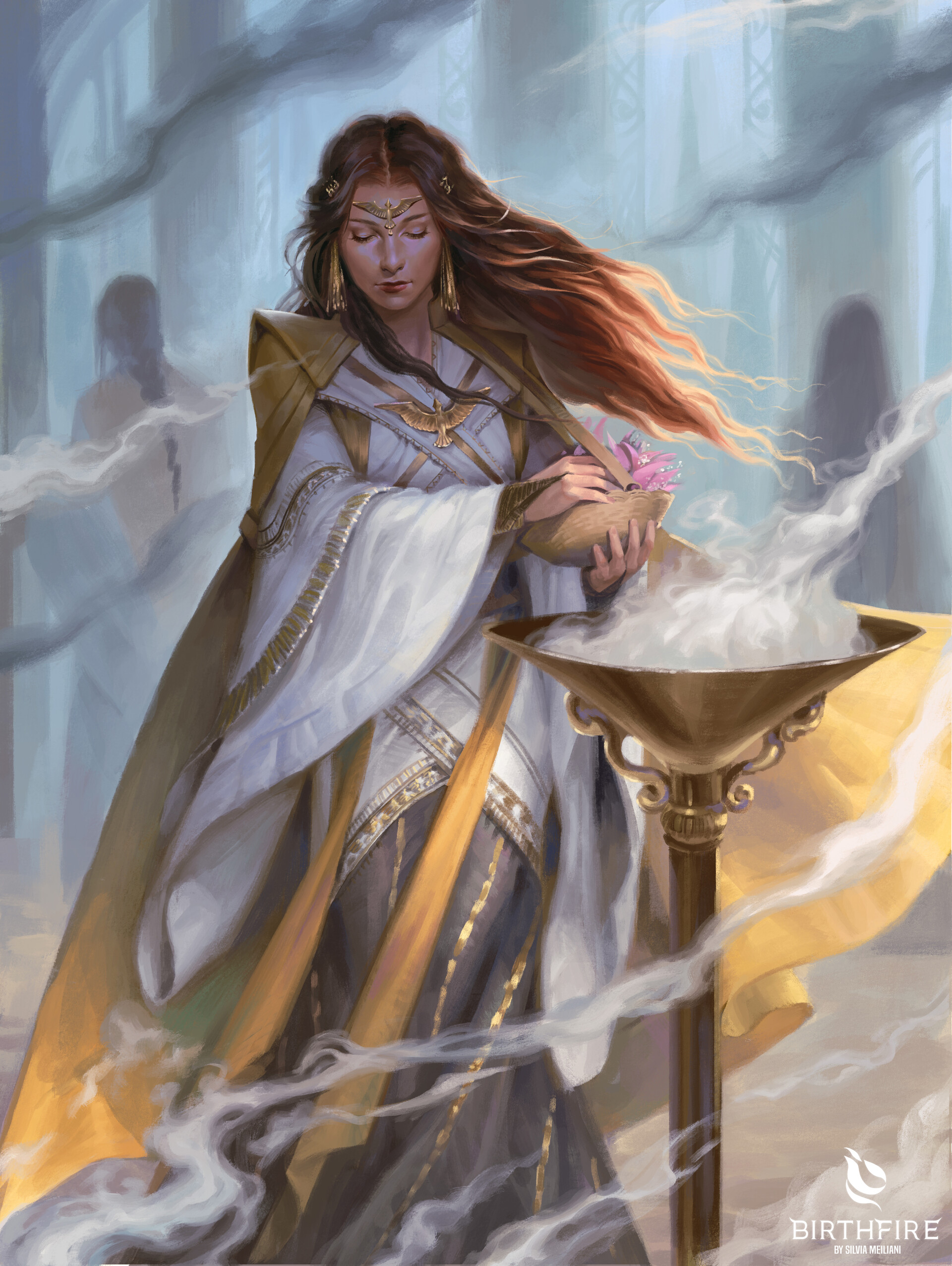
May You Be Spared G_d's Judgment (GLOG Classis: Cleric)

Priest. Ardent. Wise One. Monk. Known by many names across many lands, you are one favoured by the G_ds, blessed with some small semblance of their power. You may be part of an organised faith, a devout member of a once-mighty cult, a lone pilgrim on a holy path entirely your own, or any number of things; as long as you work in service to some G_d, hold some sway with Those Of HEAVEN, this may be the class for you.

By Silvia Meiliani

Starting items: signifier of your faith (embroidered robes, porcelain mask, tattoo, &c.), a walking staff, a small weapon, a prayer scroll or sacred text
Skills: religion and (1d3) public speaking, history, or commerce

A: Voice of the G_ds: Common folk recognise you as a person of religious disposition. People are keen to take any advice, counsel, or explanations you offer them, and will likely offer temporary sanctuary or a meal in return for any favours. Oaths said afore you are considered binding, and you may oversee religious ceremonies of many sorts.

A: Augury: You may perform a ritual—as outlined in your particular domain's description—to discern some truth about the world. Roll [template]d6 each time you do, asking up to [highest] questions. Answers given take the form of 'Yes', 'No', or 'Unclear'; if the question relates to your domain, instead you may receive 'Certainly', 'Possibly', 'Unclear', 'Consider Further', 'Unlikely', or 'Impossible'.

B: Reveal Deception: You can sense if those you meet are opposed to the interests of your domain, and dispel illusions & invisibility with a minute of concentration. You may spend ten minutes to ward a site against intruders until sunrise; any unwanted entry immediately alerts you.

B: Proselytize: Whenever you preach in a crowded place, you draw an audience including [template]d6 believers; afterwards, you may hire up to [template] of them on as hirelings to follow you. All believers—those paid and those not—will treat you with reverence and perform small domain-appropriate favours as you instruct, provided they don't aren't put in jeopardy as a result. 

C: Turn: You may force those opposed to you and your domain to test morale; on a failure, they will cower before you or flee in terror. If they succeed, you cannot turn them again until the next day.

D: Sect: You may start a splinter of your own. Make sure to note some distinguishing tenets or heresies, preferably ones your character already holds to. Hirelings you choose to ordain count as CHOSEN of the first level, with your title passing to one of them when you die.

G_ds Great and Small

1. Idona, the Watcher, They Who Birthed Nations
Domains: Time, Life, Death
The First God, from whom came all and unto shall all return. They were among those who raised the Mountain from the depths of Chaos, but refused to rule from the Throne of Heaven. Burial is but a return to their embrace, for the devoted. Patron of midwives, gravediggers, and all those who care deeply for others.

Starting items: Your holy symbol is a golden circle hanging from a chain necklace, your weapon a half-moon sickle. In addition, you carry a copy of Alsther Wisborne's Alamanac of Common Kyures and Ailments and a roll of bandages.
Augury: You know the True Tongue of ancient things; you may spend an hour in contemplative silence to consult with the souls of rock and stone, those mighty forests that stood long before mankind lay foot in these lands.
Benefit: You have knowledge of many non-magical diseases, as well as simple cures for them. You may craft poultices from common herbs, and have enough training to lessen the long-term effects of a wound provided you get to it within a day.
Drawback: When an innocent in need requests your help, your oaths oblige you to help; doubly so if it concerns a loved one of theirs. As a rule of thumb, an "innocent" is anyone with less than 1 HD who isn't trying to start a fight.

2. Tadhros, the Burning One, She Who Scattered the Stars
Domains: Fire, Light, Violence
The sun, by whose light the world may live. A thousand times she led her armies against the forces of endless night, a thousand times mankind saved by their shed blood. Only once her armies' swords laid to rest, a thousand sacrifices made at once to banish the dark forever more, their bodies scattered now across the blackness.

Starting items: Your holy symbol is a robe emblazoned with a white sun, your weapon a short sword. In addition, you carry three sticks of heavily-scented incense.
Augury: Light a fire, burning something of value—1gp or sentimental memory per question—and stare at its heart. It will burn itself out in ten times [dice] minutes; you may derive answers from the ashes.
Benefit: You may snap your fingers at any time to create a spark as that of a flint and steel.
Drawback: You are forbidden to put out a fire before it burns itself out naturally. All food you eat must be cooked.

3. Solgrannis, Plague-Bearer, Who Lurks in the Night
Domains: Disease, Squalor, Darkness
Be it demon or g_d true, all who know his name know it something to be feared. Uncountable tales of its nature are told across lands near and far, by drunkards in tavern corners and old wives at the village well, tales of a great shambling blackness, a lurching corpse crowned in blood, a foul beast and devourer of children. Each bears some facet of its truth, each is wildly wrong. As the dark itself, he resists comprehension, an ever-shifting form lying just beyond reach.

Starting items: Your holy symbol is a porcelain mask, the face of a plague-bearer transfixed in pain, your weapon a ritual dagger. In addition, you carry a single dose of strongly hallucinogenic fungus and are followed by a raven.
Augury: Slit the belly of a freshly-deceased corpse and make a reading of its internal parts. A hare provides enough entrails for a single question, a human around three.
Benefit: You speak the tongue of all the foul things that prowl in shadow—you may hold conversation with rats, mice, and scavenging beasts as though fluent, though they may not be inclined to listen to you.
Drawback: You posses a permanent whooping cough. People may react as they would to any other sick person, even while the recognise you for a holy person.

Saturday, July 10, 2021

Don't Forget the Fine Print

I burned my life, that I might find
A passion wholly of the mind,
Thought divorced from eye and bone,
Ecstasy come to breath alone.
I broke my life, to seek relief
From the flawed light of love and grief.
—Louise Bogan, 'The Alchemist'

A follow-up to an earlier post of mine; another patron, another pact.

Patron: The Deep

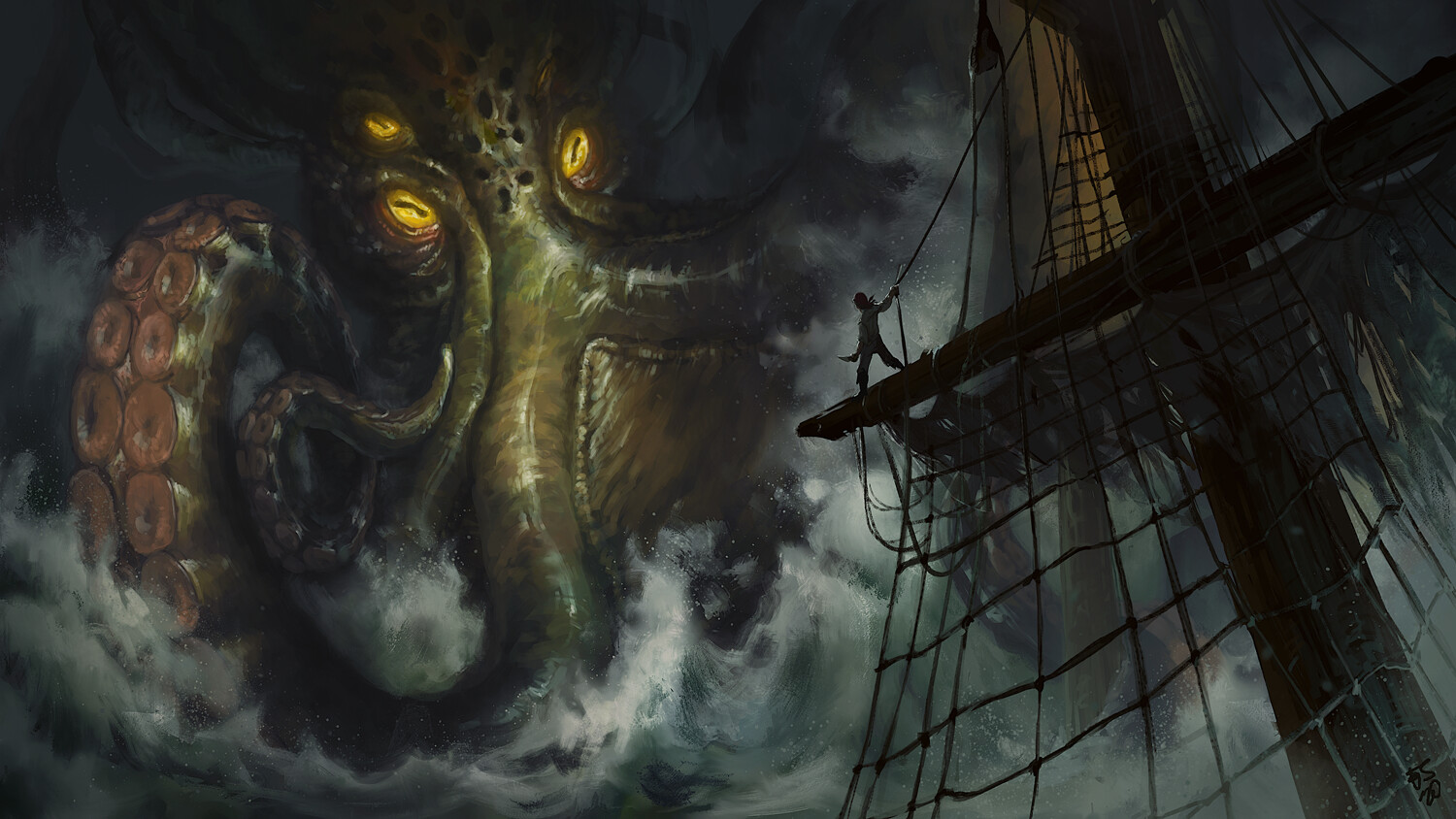
Be it a Great Beast of the Sea, a mighty kraken, or a primordial of the Elemental Ocean, you have bound yourself to some ancient being from creation’s first days. For some masters, you may act as their eyes and ears on the realm of land, advancing whatever esoteric goals they seek; for others, your "master" may be so alien as to be unaware of your mere existence.

By Elisa Serio

Perk: You can communicate with creatures of the water as fluent, and move through marshes and bogs unhindered.
Drawback: You cannot drink fresh water; derivatives thereof—tea, beer, &c—are fine.

The boon of your pact looks as it should for an object of the oceans—dark blues and greys, seaweed dangling off of it, a thin layer of slime, &c.

Those who swear themselves to a being of the Deep carry a sign of their pact. The mark you bear takes the form of...
1. Webbed hands and feet.
2. Translucent, mildly luminescent skin.
3. Fish-like scales.
4. Visible gills.
5. Constantly damp & oily skin.
6. No eyelids.
7. Unnaturally pointed teeth.
8. Unusual pallor.
9. Bulbous swim bladders.
10. Spit solidifies slowly after contact with air.

Mishaps:
1. 1d6 damage to you.
2. MD only return to your pool on a 1-2 until sunrise.
3. Random marine-related mutation for 1d6 rounds. Permanent on a failed save.
4. Lungs temporarily fill with water for 1d6 rounds. Can't speak or cast spells.
5. Grow incredibly thirsty. Must consume a ration at next rest, and receive no healing from it.
6. Vomit 1d100 litres of seawater.

Dooms:
1. Body empties of moisture for 24 hours. Inventory filled with exhaustion, and can't cast spells.
2. As above, but for a week.
3. Tide rises where you stand. 1d20+5 assorted merfolk, water elementals, and bloated corpses appear to drag you out to sea. Fend them off or die.

Pact: The Tome

Where other practitioners take paths of simple-minded violence or request vain gifts, your boon of choice was knowledge—power in its purest form, at least in your eyes. You need not runes nor wands nor incense; you are a spellcaster, capable of imposing your whims on the world as you desire.

A: Spellcasting: You may expend MD to change the world around you, wielding the powers described below. For each Working you perform past the first, add an additional Instability Die—they do not contribute to [dice] or [sum], but do count for the invocation of Mishaps and Dooms. This count resets each sunrise, though a warlock may voluntarily roll extra ID to further empower their workings.

Harm: Deal [sum]+[dice] damage to any target you can see; creatures may Save to negate. This takes a pact-appropriate form—a blast of fire, a sudden gust of lacerating wind, the howling screams of damned souls.
+1 ID for each other Working you've done since sunrise
+1 ID for each additional target

Alter: Make a declarative statement about any target you can see you can see. That statement becomes true for [dice] rounds. It cannot cause damage (Harm), create a new object (Create), or move the target; creatures may Save to negate.
+1 ID for each other Working you've done since sunrise
+1 ID for each additional target
+1 ID to affect an area the size of a wagon
+2 ID to affect an area the size of a cottage
+3 ID to affect an area the size of a village
+1 ID to make the effect last [dice] minutes
+2 ID to make the effect last [dice] hours
+3 ID to make the effect last [dice] days

Create: Create a creature or object. It lasts for [dice] rounds, and begins person-sized or smaller (with 2 or fewer HD if a creature). Creatures created cannot inflict damage and objects may not inflict magic damage or create permanent effects, but may be magical—you can make a flying carpet, but a healing potion will only last the duration listed. A regular sword, not BITTER MARTYR WOE, a well-learned heavy langmesser matte, with a silvered edge that cuts through fire.
+1 ID for each other Working you've done since sunrise
+1 ID for each additional creation
+2 ID to increase the created creature's HD by 4
+1 ID to create an object the size of a wagon
+2 ID to create an object the size of a cottage
+3 ID to create an object the size of a village
+1 ID to create a magical or otherwise notably strange object
+1 ID to make the creation last [dice] minutes
+2 ID to make the creation last [dice] hours
+3 ID to make the creation last [dice] days

A: Ancient Tongues: When you come across a fragment of some long-forgotten language—scrawled on a ruin, carved into a talisman, &c.—you have a [templates]-in-6 chance of understanding it. Not the entire language, but enough for that piece.

B: Intuitive Understanding: You can read any text—fine print included—in the time it's taken you to read this description.

C: Accurate Insight: By staring very deeply into someone's eyes, you may read their thoughts, quite literally printed on their pupils; it's there for everyone, but the text is very small (credit to Archon).

D: Spell-Theft: You may cast any spell you come across in another magic-user's grimoire or the mind of one you've killed without rolling or incurring ID. Your Mishaps and Dooms may still apply; spells cast this way once are rendered unusable.


The Magic-User to the Blade's Fighting-Man. Thanks to Sundered for the name; here's the patron you asked for in return. Feedback appreciated, &c., &c.—more patrons and pacts to come.

Monday, July 5, 2021

The City Who Slumbers Not

City! I am true son of thine;
Ne’er dwelt I where great mornings shine
Around the bleating pens;
Ne’er by the rivulets I strayed,
And ne’er upon my childhood weighed
The silence of the glens.
Instead of shores where ocean beats,
I hear the ebb and flow of streets.
—Alexander Smith, 'Glasgow'

The City is an old thing, built long before living memory. It reaches out endlessly in every direction—east & west, up & and down, inward & out. Layers of new creation spring up over layers of ruin, the old consumed to make way for the present. Petty factions vie for power, each eager to further their goals and advance their standing—councils, unions, cults, and consortiums of all stripes always interfering in each other's works.

The City is alive, change its near-sole constant; a fixed map is of little use to anyone, save perhaps as something to blow your nose with. Everything in the City matters to someone; quite who might not matter yet, but they do exist. Life is everywhere, even in those bits abandoned by humanity.

By Stephan Martiniere

The Sewer-Ferry Syndicate

The Sewer-Ferry Syndicate are one of the City's most wealthy purveyors of transport, providing passage all across its lower regions. They provide financial and military backing to gondoliers and boat captains of all kinds, undercutting or threatening any potential operators who refuse to pay their dues. They often draw the ire of those who call the sewers their home—the Rat-Speakers, fungus cults, &c.—and are quick to ally themselves to those who might see the City's annals 'cleaned up', as it were.

Goal: Outcompete financial opponents, regulate all passage through the sewage network
Allies: The Plumber's Guild, Waterworks, the Sludgemarket
Enemies: Other transport suppliers, the splintered Fishing Coalition, native denizens of the sewer system

The Church of Urbis

Members of the Church of Urbis are worshippers the City itself, ever-eager to perform good deeds in Her service. They revere those who work to maintain Her various boroughs and enclaves, and often take it upon themselves to clean up messes or decorate empty spaces in Her honour. They deride other forms of faith as idolatry and heresy, including those who worship the City in the "wrong" ways. Bureaucrats, lawmen, and officers of local governments are among the Church's most common adherents.

Goal: Convert all to the light of the City's worship.
Allies: Hapsmire District Council, the Street-Sweeper's Guild
Enemies: Litterers, loiterers, other faiths (especially the Cult of Metros)

Their Majesty's College of Wizardly Study

No one quite recalls whose majesty the College was named in reference to, but the College Board's bureaucracy thinks it adds an air of grandeur. It is but one among many institutions offering tutelage in the practice of magic, each eager to draw the eye of new prospective students to extort for money and saddle with debt shape into the next generation of scholars! The College is particularly renowned among its peers for its research into spatial manipulation, though accusations remain of stolen experiments; total codswallop, of course.

Goal: Provide as much return to investors as possible education to all who desire (and can afford) it!
Allies: Very little; the academic world is one of spite, not friendship.
Enemies: Agselsior University, the Institute of Elemental Arts, Gdinsleslav Academy; the list goes on.

1d50 factions for player characters to love, hate, or owe copious amounts of money to:

Saturday, June 12, 2021

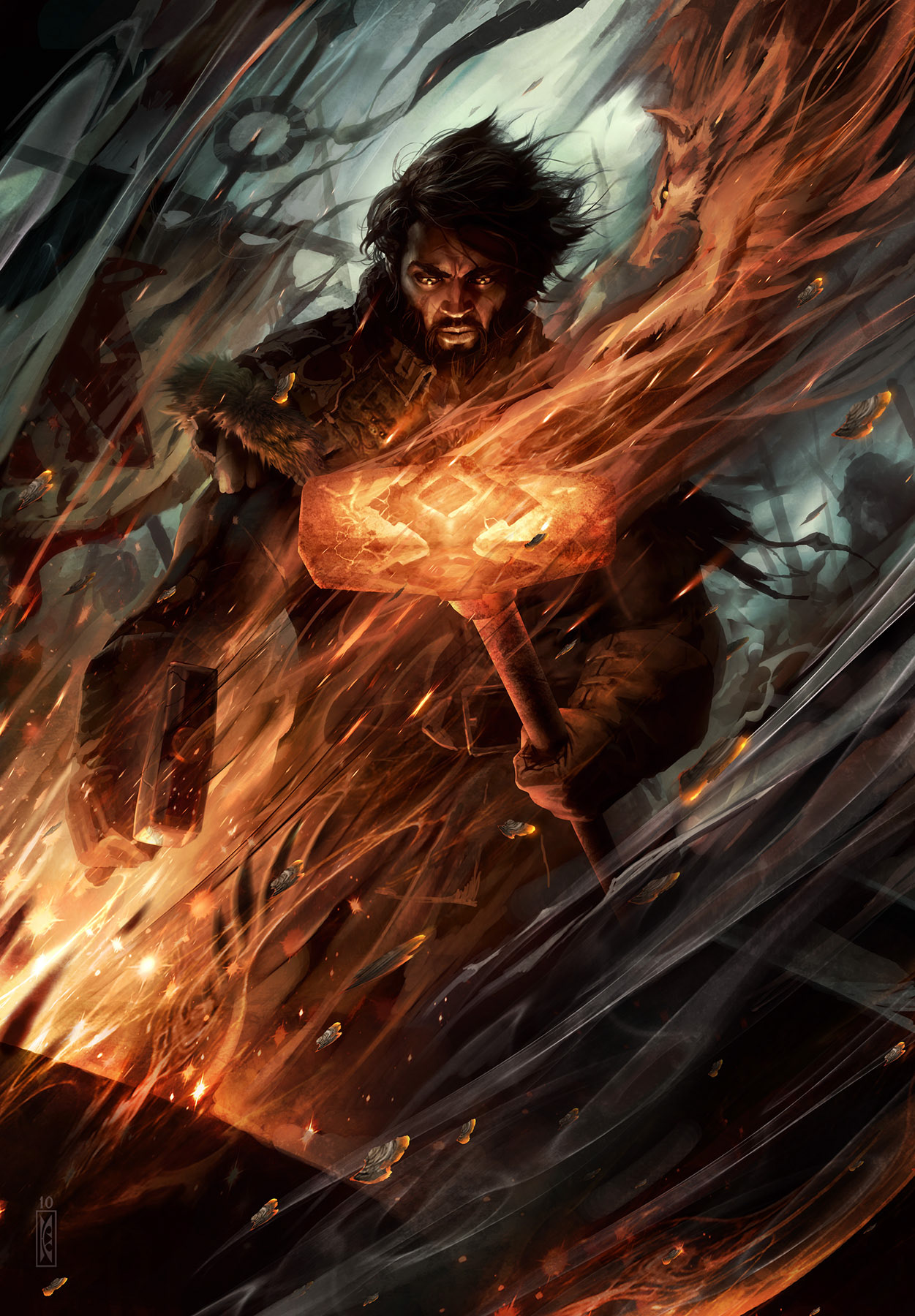
DISCIPLE OF THE FORGE (GLOG Class)

You are a devotee of Caelis, the Smith, endowed with a fragment of his power either through intent or accident—you may have drawn his attention, forged a pact, or simply swallowed an odd bit of metal. You do not necessarily worship him—indeed, many have turned their back on the G_ds of old—but you follow in his path nonetheless.

By Raymond Swanland

Starting items: smith's tools and leathers, a sacred icon, a medium weapon, a surprisingly portable anvil, 3d4 bits of thumb-sized metallic junk
Skills: metalwork and (1d6): appraisal, architecture, percussive maintenance, bartering, clockwork, scripture

A: Blessings of the Forge, Reshape
B: Artisan's Gifts, Kindling
C: Steel-Saint
D: Reforged

Blessings of the Forge: You may infuse up to [template] items with magic at any given time; the process takes an hour of constant prayer recital. Blessed objects never rust nor tarnish, cannot be damaged by mundane means, and count as magical.

Reshape: You can mold metal in your hands with the ease and accuracy of soft clay. Anything crafted this way is liable to fall apart after 1d6 uses.

Artisan's Gifts: You may replicate any object in metal perfectly, provided you have the original to hand. The process takes minutes for simple things smaller than your hands, hours for something more complex or about as large as an arm, and days or weeks for the largest or most intricate work.

Kindling: You can rub any two flammable objects together in between your palms to set both alight, at no immediate risk to yourself.

Steel-Saint: Damage dealt by blessed objects scalds as boiling water. You may transmute earthen materials (soil, rocks, bone, so on) into workable metal—a fist-sized quantity in a minute, a light sword's worth in 10, &c. It is weaker than natural ore, but just as usable for your purposes.

Reforged: The flame has altered your soul and body alike. Mundane fire is no longer dangerous to you, and objects bearing your blessing strike with all the force of a falling anvil.


𝟭𝟯 𝗔𝗡𝗗 in the earliest days, when Man was but an idle thought, the G_ds did wrest from Chaos the reigns of creation, and the Void they did fill. The Mountain was raised by the Daughters of the Earth—Keldat, Maken, Isla, Tarn all—and at its peak was raised the City now called Heaven, that place of bounty now marred by War. And in that City were made wonders, true works of the divine, beyond the design of the finest craftsmen and beyond the mind of the highest King of Kings among all on earthen soil, each a miracle in its own. 

𝟭𝟵 𝗔𝗟𝗦𝗢 among their number, those architects of the Sacred City, stood the Firesoul, the Smith, He Who is Called by the Heat of the Forge; that divinity known in the True Tongue by the clang of the hammer; in the old speech of the first peoples, Klissian; and in the common tongue of those born in the wreckage of the Scattering, Caelis.

𝟮𝟬 𝗛𝗘 shaped the fruit of the earth as none other, not merely reshaping it but forming it anew in whole, creating new substance from the ancient and molding it as he pleased. By him were forged the weapons that slayed Those Who Came Before, before the birth of the Mountain and its Heaven—the blade of Nazgas, the powerful one swung about the head of Tel'turon, the mighty bow lost-to-the-ages—and within the City his works were many. Grand palaces of iron, mighty towers as tall as the Mountain itself, new constructions, unlike any come before; to list his works would be as futile as the singing of his endless praises.
—Excerpts from Lebor Breth-Sleev ags a Bhailid, The Book of the Birth of the Mountain and its City, translated in the year 724 by Brother Benedach


A GLOG-ish spin on one of the more tolerable 5e subclasses, albeit with a number of creative liberties. Kindling stolen from deus ex parbaked's Manufactory. All feedback appreciated, especially on the ~faithposting~ at the end.

Sunday, May 9, 2021

Written in Blood

Warlocks. Foul creatures, born of human stock and bound to some higher being for power. Each is defined first by patron and second by pact; the entity to which they owe their power, and the gifts they receive.

You and your compatriots are some such wretched beings.

Michael Maier

At each level, warlocks gain a Magic Die, a d6 representative of some shred of power or minor favour owed to you. Some pact abilities give you the opportunity to roll them. [dice] is the amount of MD you commit, [sum] is the total of all results. MD are expended on a 4-6; dice that roll lower return to your pool to be rolled anew. Whenever you roll doubles, consult your patron's Mishap table; the corresponding result occurs (double sixes result in the sixth entry, double threes the third, &c.).

All warlocks are fated to meet their demise. Whenever a Mishap occurs, note it. Whenever you make the third strike, a Doom is invoked—some greater catastrophe. As with Mishaps, the exact consequences depend on your choice of patron. Few, if any, survive their third Doom.

Patron: The Fiend

Hob. Old Scratch. The Devil. The Fiend bears a thousand names in as many different tongues, but all refer to the same being—the lord themself of the lower planes. They seek to bring out the worst in humanity; violent, impulsive, brutal. All in their thrall embody these virtues, in one way or another.

Michal Kváč

Perk: Can summon a flame as that of a candle with a snap of the fingers.
Drawback: Sacred objects burn to touch.

The boon of your pact—book, sword, or servant—looks as an object of the Hells should. Earthen or crimson tones, a charred scent, wicked spikes, infernal inscriptions.

To forge a pact with the Fiend—whether you sought it out, or it was brought to you—one must take a dip in the fires of the underworld. Few pilgrims make it through unscathed. The mark you bear takes the form of...
1. A marred face.
2. Eyes turned an unnatural shade.
3. A pair of horns jutting from your forehead.
4. An arm-length tail.
5. A shadow twice the length it should be.
6. Breath that reeks of brimstone.
7. A network of scars across your forearms.
8. Bodily fluids (blood, sweat, tears, &c) the deepest black.
9. Nails as sharp as claws.
10. An extra set of canine teeth, jutting out of your mouth.

Mishaps:
1. 1d6 damage to you.
2. MD only return to your pool on a 1-2 for 24 hours.
3. You lose all benefits of your boons for 1d6 rounds.
4. Random hellish mutation for 1d6 rounds. Save with advantage or permanent.
5. Fire spurts out from you. 1d6 damage to you and everything within 2 metres.
6. An imp pops into existence. They seek to cause maximum mischief for those around them until killed and can summon minor illusions—cause flames to flicker or dim, slam open doors shut, call forth harmless tremors, &c.

Dooms:
1. Die for a day. Your soul is taken temporarily to the Underworld, for fiends to do with as they please.
2. As 1, but for the person you care about most in the world.
3. As 1, but for eternity.

Pact: The Blade

You have chosen a path of violence. Your boon takes the form of a weapon of your choice—dagger, sword, axe, &c. You are as skilled with it as any other combatant, and are bound to the blade as much as it is to you.

Gilles Ketting

A: Boon of the Blade: You have taken a weapon of your choice as the object of your pact. It counts as magical, its appearance influenced by your choice of patron. It vanishes into nothing when separated from your or at a moment's thought, and you can summon it from the aether with 10 heartbeats of concentration (a single action in combat).

A: Bloodthirsty Edge: Whenever you make a successful attack against an enemy, you may roll any amount of MD. If you choose to do so, the attack inflicts an extra [dice] damage. Upgrades to [sum] at C.

B: Deft Hands: You've grown more comfortable in your weapon. You never fail to do things with it other than attack—disarming enemies, tripping foes, striking them with the flat of the blade, &c.

C: Indomitable: Your body has improved, infused further with magic. You can roll MD when making saves to add an additional [sum] to your result; whenever you step out of the fight for a moment to take a breather, you may regain [dice] health rather than the norm. 

D: Flurry of Steel: You have been gifted a preternatural speed in combat. You can make two attacks with your pact weapon on each of your turns without penalty. 


The beginnings of a potential hack, of sorts, replacing the 'race'/class dichotomy with patron and pact. Hopefully makes a degree of sense. Feedback of all forms appreciated—as are riffs on the same concept.