Sunday, February 27, 2022

Unwaking from the Dream of Life (The Lich)

Why should a man desire in any way
To vary from the kindly race of men
Or pass beyond the goal of ordinance
Where all should pause, as is most meet for all?
—Alfred Tennyson, 'Tithonus'

A mage, great in power and hubris both, who has overcome Death itself. Trading form for immortality, liches give up their bodies, binding their mind instead to their demesne—a fortress-city, a citadel of bone, perhaps an ancient tower—saving themselves from the tides of time, but binding themselves in place for eternity. Thus, they rely on agents to act on their behalf beyond the borders of their demesne.

By Blake Rottinger

Perk: You speak the tongue of spirits. Passing on decays the mind; corpses often ramble or go on cryptically, and rarely can they recall their deaths.
Drawback: You do not heal naturally. Instead of a ration, you must consume the flesh of a freshly slain creature; broken bones must be replaced with ones scavenged from elsewhere.

The boon of your pact looks as something pulled from a long-forgotten tomb—it might be composed of bone or dark stone, it may look worn with age, it may bear a permanent layer of dust, &c.

All who are sworn to a lich are... twisted, in some way, by their bond. The mark you bear takes the form of...
1. Ghost-pale skin.
2. An ever-present chill.
3. Entirely black eyes.
4. A constant gauntness.
5. A pungent scent of rotting flesh.
6. Permanent bloating.
7. Teeth eerily long and yellow as old bone
8. A different voice, much older than your face.
9. Nothing humans can sense, but animals find you... wrong.
10. One eye that never ceases weeping.

Mishaps:
1. 1d6 damage to you.
2. MD only return to your pool on a 1-2 until sunrise.
3. Random mutation for 1d6 rounds, then make a Save. Permanent if you fail.
4. For the next [sum]*10 minutes, you may see into the realm of spirits and magic directly, but the mortal world is totally dark to you (stolen from Lexi). 
5. 1d6 nearby corpses raise as revenants, eager to attack.
6. Save against your body rejecting your spirit. If failed, your spirit shoots out of you as a ghost - choose which one you're controlling, the other causes mayhem. The ghost can do spells and wizardy shit, the body can and will break things and strangle people (courtesy of Locheil).

Dooms:
1. You die. Your spirit is flung from your body until the next sunrise, and from now on you are as any other undead—your form will begin to rot, and you gain another feature from the d10 table above.
2. As above, but your body's rotting progress more rapidly while you are outside it. Disadvantage on initiative rolls and any checks related to reflexes or speed from now on.
3. As above, but your spirit is cast out forever. Your passing tears a hole in the Veil. 4d8 spirits leak through, possessing nearby corpses where available and hellbent on causing harm.

----------------------------------------------------------------------

A continuation from some earlier posts.

Wednesday, December 15, 2021

d6 Doors

Maybe there is more of the magical
in the idea of a door than in the door
itself. It’s always a matter of going
through into something else.
—Marge Piercy

1. A handmade wooden wardrobe, carved lions for feet and a leaflike pattern inscribed on the doors. A maker's mark was once visible, but has worn away with age. Currently located in the private collection of an eccentric antiques dealer.

2. A ruined arch of time-weathered stone, cloaked in moss. It lies secret in the forests of the north, in a clearing all its own among the trees. It bears no sign of having been part of another construction, and cannot be found by those who seek it without having visited it before.

3. A door under the stairs of an unassuming suburban home—things stored in it have a habit of disappearing, and that which is found is often not what was left. The owners take little note of this; a collective refusal to acknowledge the truth has convinced the family that uncle Darrell died in a car crash.

By Alexandra Petruk

4. A mirror, currently stored in the bowels of a cathedral. Rectangular in shape and tall in size, its gilt frame depicts dozens of animals and plants. Its inscription, a rhyming couplet in the tongue of snakes and foxes, advises all those who enter to "keep one eye in front and one behind". 

5. A cave, hidden behind a crashing waterfall. Stalactites dot the ceiling, and the air is heavy with the rank scent of mildew. Fog drifts out from some hidden source deep within the cave; those who exit discover themselves somewhere different, most often dizzy or confused.

6. A barrow mound containing the bones of a nine-foot tall giant, buried alongside a sword half his height and a dozen desiccated rats. It can only be properly entered at auspicious times of year—solstice or equinox most particularly.

Wednesday, August 4, 2021

May You Be Spared G_d's Judgment (GLOG Classis: Cleric)

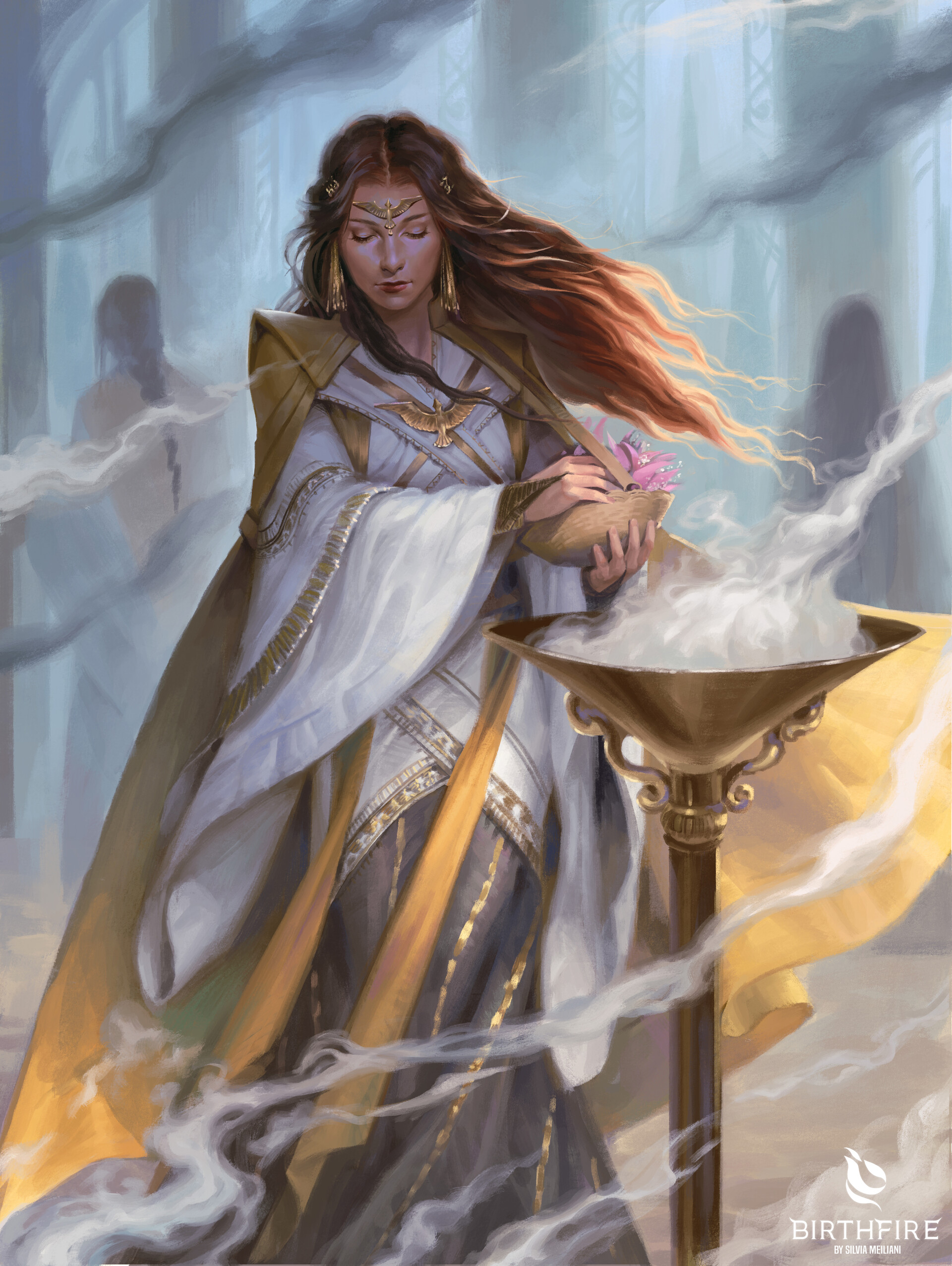
Priest. Ardent. Wise One. Monk. Known by many names across many lands, you are one favoured by the G_ds, blessed with some small semblance of their power. You may be part of an organised faith, a devout member of a once-mighty cult, a lone pilgrim on a holy path entirely your own, or any number of things; as long as you work in service to some G_d, hold some sway with Those Of HEAVEN, this may be the class for you.

By Silvia Meiliani

Starting items: signifier of your faith (embroidered robes, porcelain mask, tattoo, &c.), a walking staff, a small weapon, a prayer scroll or sacred text
Skills: religion and (1d3) public speaking, history, or commerce

A: Voice of the G_ds: Common folk recognise you as a person of religious disposition. People are keen to take any advice, counsel, or explanations you offer them, and will likely offer temporary sanctuary or a meal in return for any favours. Oaths said afore you are considered binding, and you may oversee religious ceremonies of many sorts.

A: Augury: You may perform a ritual—as outlined in your particular domain's description—to discern some truth about the world. Roll [template]d6 each time you do, asking up to [highest] questions. Answers given take the form of 'Yes', 'No', or 'Unclear'; if the question relates to your domain, instead you may receive 'Certainly', 'Possibly', 'Unclear', 'Consider Further', 'Unlikely', or 'Impossible'.

B: Reveal Deception: You can sense if those you meet are opposed to the interests of your domain, and dispel illusions & invisibility with a minute of concentration. You may spend ten minutes to ward a site against intruders until sunrise; any unwanted entry immediately alerts you.

B: Proselytize: Whenever you preach in a crowded place, you draw an audience including [template]d6 believers; afterwards, you may hire up to [template] of them on as hirelings to follow you. All believers—those paid and those not—will treat you with reverence and perform small domain-appropriate favours as you instruct, provided they don't aren't put in jeopardy as a result. 

C: Turn: You may force those opposed to you and your domain to test morale; on a failure, they will cower before you or flee in terror. If they succeed, you cannot turn them again until the next day.

D: Sect: You may start a splinter of your own. Make sure to note some distinguishing tenets or heresies, preferably ones your character already holds to. Hirelings you choose to ordain count as CHOSEN of the first level, with your title passing to one of them when you die.

G_ds Great and Small

1. Idona, the Watcher, They Who Birthed Nations
Domains: Time, Life, Death
The First God, from whom came all and unto shall all return. They were among those who raised the Mountain from the depths of Chaos, but refused to rule from the Throne of Heaven. Burial is but a return to their embrace, for the devoted. Patron of midwives, gravediggers, and all those who care deeply for others.

Starting items: Your holy symbol is a golden circle hanging from a chain necklace, your weapon a half-moon sickle. In addition, you carry a copy of Alsther Wisborne's Alamanac of Common Kyures and Ailments and a roll of bandages.
Augury: You know the True Tongue of ancient things; you may spend an hour in contemplative silence to consult with the souls of rock and stone, those mighty forests that stood long before mankind lay foot in these lands.
Benefit: You have knowledge of many non-magical diseases, as well as simple cures for them. You may craft poultices from common herbs, and have enough training to lessen the long-term effects of a wound provided you get to it within a day.
Drawback: When an innocent in need requests your help, your oaths oblige you to help; doubly so if it concerns a loved one of theirs. As a rule of thumb, an "innocent" is anyone with less than 1 HD who isn't trying to start a fight.

2. Tadhros, the Burning One, She Who Scattered the Stars
Domains: Fire, Light, Violence
The sun, by whose light the world may live. A thousand times she led her armies against the forces of endless night, a thousand times mankind saved by their shed blood. Only once her armies' swords laid to rest, a thousand sacrifices made at once to banish the dark forever more, their bodies scattered now across the blackness.

Starting items: Your holy symbol is a robe emblazoned with a white sun, your weapon a short sword. In addition, you carry three sticks of heavily-scented incense.
Augury: Light a fire, burning something of value—1gp or sentimental memory per question—and stare at its heart. It will burn itself out in ten times [dice] minutes; you may derive answers from the ashes.
Benefit: You may snap your fingers at any time to create a spark as that of a flint and steel.
Drawback: You are forbidden to put out a fire before it burns itself out naturally. All food you eat must be cooked.

3. Solgrannis, Plague-Bearer, Who Lurks in the Night
Domains: Disease, Squalor, Darkness
Be it demon or g_d true, all who know his name know it something to be feared. Uncountable tales of its nature are told across lands near and far, by drunkards in tavern corners and old wives at the village well, tales of a great shambling blackness, a lurching corpse crowned in blood, a foul beast and devourer of children. Each bears some facet of its truth, each is wildly wrong. As the dark itself, he resists comprehension, an ever-shifting form lying just beyond reach.

Starting items: Your holy symbol is a porcelain mask, the face of a plague-bearer transfixed in pain, your weapon a ritual dagger. In addition, you carry a single dose of strongly hallucinogenic fungus and are followed by a raven.
Augury: Slit the belly of a freshly-deceased corpse and make a reading of its internal parts. A hare provides enough entrails for a single question, a human around three.
Benefit: You speak the tongue of all the foul things that prowl in shadow—you may hold conversation with rats, mice, and scavenging beasts as though fluent, though they may not be inclined to listen to you.
Drawback: You posses a permanent whooping cough. People may react as they would to any other sick person, even while the recognise you for a holy person.

Saturday, July 10, 2021

Don't Forget the Fine Print

I burned my life, that I might find
A passion wholly of the mind,
Thought divorced from eye and bone,
Ecstasy come to breath alone.
I broke my life, to seek relief
From the flawed light of love and grief.
—Louise Bogan, 'The Alchemist'

A follow-up to an earlier post of mine; another patron, another pact.

Patron: The Deep

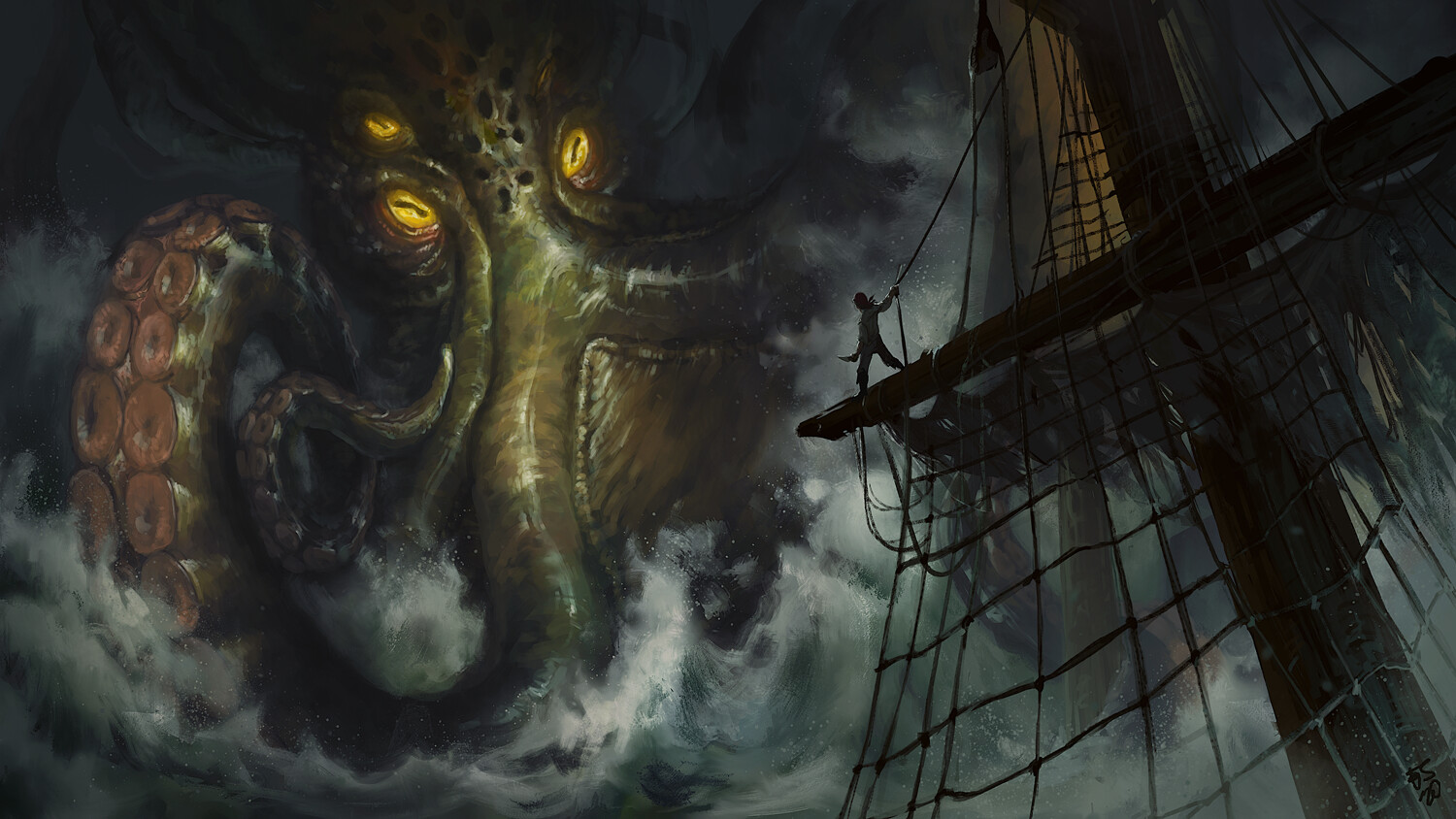
Be it a Great Beast of the Sea, a mighty kraken, or a primordial of the Elemental Ocean, you have bound yourself to some ancient being from creation’s first days. For some masters, you may act as their eyes and ears on the realm of land, advancing whatever esoteric goals they seek; for others, your "master" may be so alien as to be unaware of your mere existence.

By Elisa Serio

Perk: You can communicate with creatures of the water as fluent, and move through marshes and bogs unhindered.
Drawback: You cannot drink fresh water; derivatives thereof—tea, beer, &c—are fine.

The boon of your pact looks as it should for an object of the oceans—dark blues and greys, seaweed dangling off of it, a thin layer of slime, &c.

Those who swear themselves to a being of the Deep carry a sign of their pact. The mark you bear takes the form of...
1. Webbed hands and feet.
2. Translucent, mildly luminescent skin.
3. Fish-like scales.
4. Visible gills.
5. Constantly damp & oily skin.
6. No eyelids.
7. Unnaturally pointed teeth.
8. Unusual pallor.
9. Bulbous swim bladders.
10. Spit solidifies slowly after contact with air.

Mishaps:
1. 1d6 damage to you.
2. MD only return to your pool on a 1-2 until sunrise.
3. Random marine-related mutation for 1d6 rounds. Permanent on a failed save.
4. Lungs temporarily fill with water for 1d6 rounds. Can't speak or cast spells.
5. Grow incredibly thirsty. Must consume a ration at next rest, and receive no healing from it.
6. Vomit 1d100 litres of seawater.

Dooms:
1. Body empties of moisture for 24 hours. Inventory filled with exhaustion, and can't cast spells.
2. As above, but for a week.
3. Tide rises where you stand. 1d20+5 assorted merfolk, water elementals, and bloated corpses appear to drag you out to sea. Fend them off or die.

Pact: The Tome

Where other practitioners take paths of simple-minded violence or request vain gifts, your boon of choice was knowledge—power in its purest form, at least in your eyes. You need not runes nor wands nor incense; you are a spellcaster, capable of imposing your whims on the world as you desire.

A: Spellcasting: You may expend MD to change the world around you, wielding the powers described below. For each Working you perform past the first, add an additional Instability Die—they do not contribute to [dice] or [sum], but do count for the invocation of Mishaps and Dooms. This count resets each sunrise, though a warlock may voluntarily roll extra ID to further empower their workings.

Harm: Deal [sum]+[dice] damage to any target you can see; creatures may Save to negate. This takes a pact-appropriate form—a blast of fire, a sudden gust of lacerating wind, the howling screams of damned souls.
+1 ID for each other Working you've done since sunrise
+1 ID for each additional target

Alter: Make a declarative statement about any target you can see you can see. That statement becomes true for [dice] rounds. It cannot cause damage (Harm), create a new object (Create), or move the target; creatures may Save to negate.
+1 ID for each other Working you've done since sunrise
+1 ID for each additional target
+1 ID to affect an area the size of a wagon
+2 ID to affect an area the size of a cottage
+3 ID to affect an area the size of a village
+1 ID to make the effect last [dice] minutes
+2 ID to make the effect last [dice] hours
+3 ID to make the effect last [dice] days

Create: Create a creature or object. It lasts for [dice] rounds, and begins person-sized or smaller (with 2 or fewer HD if a creature). Creatures created cannot inflict damage and objects may not inflict magic damage or create permanent effects, but may be magical—you can make a flying carpet, but a healing potion will only last the duration listed. A regular sword, not BITTER MARTYR WOE, a well-learned heavy langmesser matte, with a silvered edge that cuts through fire.
+1 ID for each other Working you've done since sunrise
+1 ID for each additional creation
+2 ID to increase the created creature's HD by 4
+1 ID to create an object the size of a wagon
+2 ID to create an object the size of a cottage
+3 ID to create an object the size of a village
+1 ID to create a magical or otherwise notably strange object
+1 ID to make the creation last [dice] minutes
+2 ID to make the creation last [dice] hours
+3 ID to make the creation last [dice] days

A: Ancient Tongues: When you come across a fragment of some long-forgotten language—scrawled on a ruin, carved into a talisman, &c.—you have a [templates]-in-6 chance of understanding it. Not the entire language, but enough for that piece.

B: Intuitive Understanding: You can read any text—fine print included—in the time it's taken you to read this description.

C: Accurate Insight: By staring very deeply into someone's eyes, you may read their thoughts, quite literally printed on their pupils; it's there for everyone, but the text is very small (credit to Archon).

D: Spell-Theft: You may cast any spell you come across in another magic-user's grimoire or the mind of one you've killed without rolling or incurring ID. Your Mishaps and Dooms may still apply; spells cast this way once are rendered unusable.


The Magic-User to the Blade's Fighting-Man. Thanks to Sundered for the name; here's the patron you asked for in return. Feedback appreciated, &c., &c.—more patrons and pacts to come.

Monday, July 5, 2021

The City Who Slumbers Not

City! I am true son of thine;
Ne’er dwelt I where great mornings shine
Around the bleating pens;
Ne’er by the rivulets I strayed,
And ne’er upon my childhood weighed
The silence of the glens.
Instead of shores where ocean beats,
I hear the ebb and flow of streets.
—Alexander Smith, 'Glasgow'

The City is an old thing, built long before living memory. It reaches out endlessly in every direction—east & west, up & and down, inward & out. Layers of new creation spring up over layers of ruin, the old consumed to make way for the present. Petty factions vie for power, each eager to further their goals and advance their standing—councils, unions, cults, and consortiums of all stripes always interfering in each other's works.

The City is alive, change its near-sole constant; a fixed map is of little use to anyone, save perhaps as something to blow your nose with. Everything in the City matters to someone; quite who might not matter yet, but they do exist. Life is everywhere, even in those bits abandoned by humanity.

By Stephan Martiniere

The Sewer-Ferry Syndicate

The Sewer-Ferry Syndicate are one of the City's most wealthy purveyors of transport, providing passage all across its lower regions. They provide financial and military backing to gondoliers and boat captains of all kinds, undercutting or threatening any potential operators who refuse to pay their dues. They often draw the ire of those who call the sewers their home—the Rat-Speakers, fungus cults, &c.—and are quick to ally themselves to those who might see the City's annals 'cleaned up', as it were.

Goal: Outcompete financial opponents, regulate all passage through the sewage network
Allies: The Plumber's Guild, Waterworks, the Sludgemarket
Enemies: Other transport suppliers, the splintered Fishing Coalition, native denizens of the sewer system

The Church of Urbis

Members of the Church of Urbis are worshippers the City itself, ever-eager to perform good deeds in Her service. They revere those who work to maintain Her various boroughs and enclaves, and often take it upon themselves to clean up messes or decorate empty spaces in Her honour. They deride other forms of faith as idolatry and heresy, including those who worship the City in the "wrong" ways. Bureaucrats, lawmen, and officers of local governments are among the Church's most common adherents.

Goal: Convert all to the light of the City's worship.
Allies: Hapsmire District Council, the Street-Sweeper's Guild
Enemies: Litterers, loiterers, other faiths (especially the Cult of Metros)

Their Majesty's College of Wizardly Study

No one quite recalls whose majesty the College was named in reference to, but the College Board's bureaucracy thinks it adds an air of grandeur. It is but one among many institutions offering tutelage in the practice of magic, each eager to draw the eye of new prospective students to extort for money and saddle with debt shape into the next generation of scholars! The College is particularly renowned among its peers for its research into spatial manipulation, though accusations remain of stolen experiments; total codswallop, of course.

Goal: Provide as much return to investors as possible education to all who desire (and can afford) it!
Allies: Very little; the academic world is one of spite, not friendship.
Enemies: Agselsior University, the Institute of Elemental Arts, Gdinsleslav Academy; the list goes on.

1d50 factions for player characters to love, hate, or owe copious amounts of money to:

Saturday, June 12, 2021

DISCIPLE OF THE FORGE (GLOG Class)

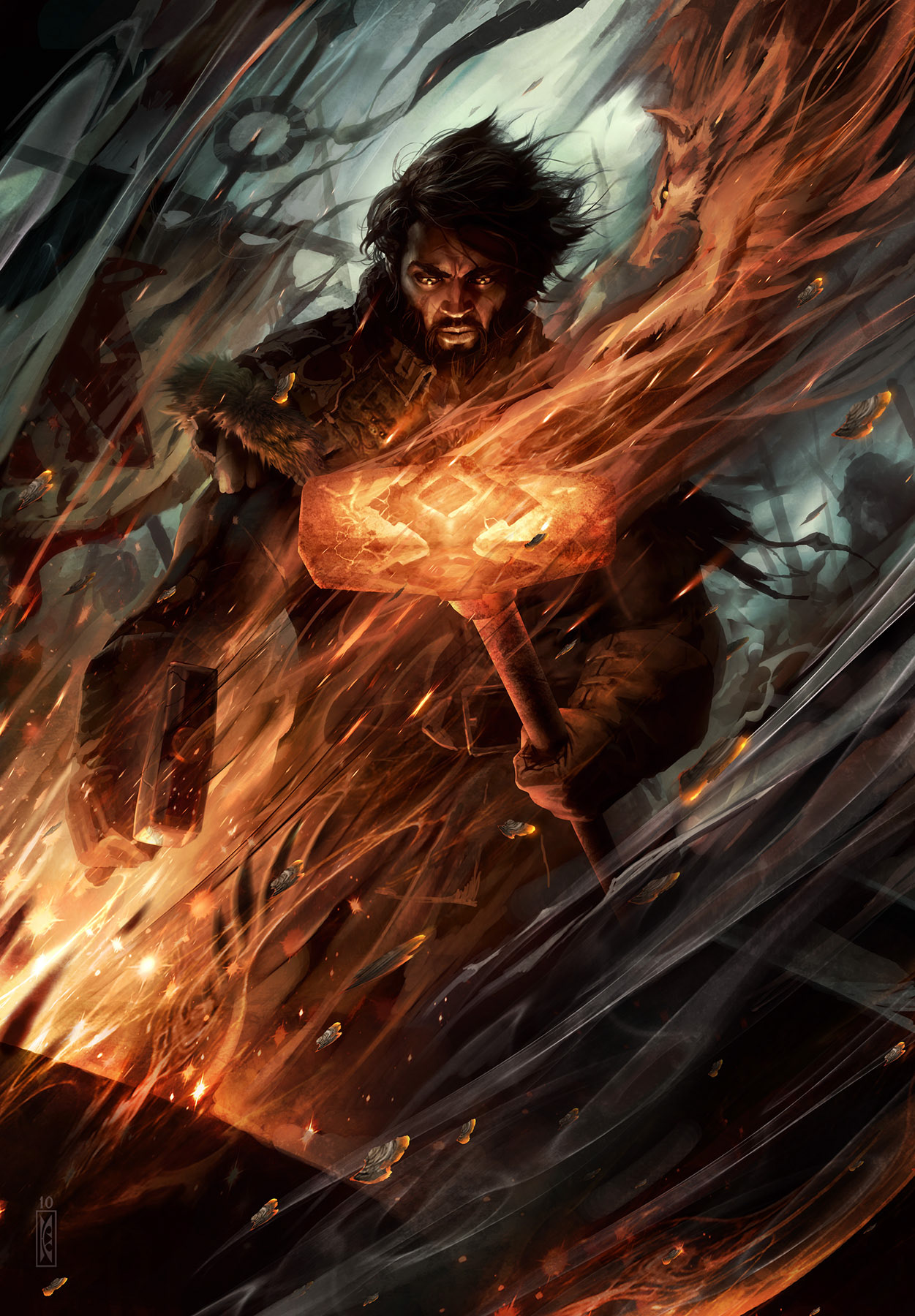
You are a devotee of Caelis, the Smith, endowed with a fragment of his power either through intent or accident—you may have drawn his attention, forged a pact, or simply swallowed an odd bit of metal. You do not necessarily worship him—indeed, many have turned their back on the G_ds of old—but you follow in his path nonetheless.

By Raymond Swanland

Starting items: smith's tools and leathers, a sacred icon, a medium weapon, a surprisingly portable anvil, 3d4 bits of thumb-sized metallic junk
Skills: metalwork and (1d6): appraisal, architecture, percussive maintenance, bartering, clockwork, scripture

A: Blessings of the Forge, Reshape
B: Artisan's Gifts, Kindling
C: Steel-Saint
D: Reforged

Blessings of the Forge: You may infuse up to [template] items with magic at any given time; the process takes an hour of constant prayer recital. Blessed objects never rust nor tarnish, cannot be damaged by mundane means, and count as magical.

Reshape: You can mold metal in your hands with the ease and accuracy of soft clay. Anything crafted this way is liable to fall apart after 1d6 uses.

Artisan's Gifts: You may replicate any object in metal perfectly, provided you have the original to hand. The process takes minutes for simple things smaller than your hands, hours for something more complex or about as large as an arm, and days or weeks for the largest or most intricate work.

Kindling: You can rub any two flammable objects together in between your palms to set both alight, at no immediate risk to yourself.

Steel-Saint: Damage dealt by blessed objects scalds as boiling water. You may transmute earthen materials (soil, rocks, bone, so on) into workable metal—a fist-sized quantity in a minute, a light sword's worth in 10, &c. It is weaker than natural ore, but just as usable for your purposes.

Reforged: The flame has altered your soul and body alike. Mundane fire is no longer dangerous to you, and objects bearing your blessing strike with all the force of a falling anvil.


๐Ÿญ๐Ÿฏ ๐—”๐—ก๐—— in the earliest days, when Man was but an idle thought, the G_ds did wrest from Chaos the reigns of creation, and the Void they did fill. The Mountain was raised by the Daughters of the Earth—Keldat, Maken, Isla, Tarn all—and at its peak was raised the City now called Heaven, that place of bounty now marred by War. And in that City were made wonders, true works of the divine, beyond the design of the finest craftsmen and beyond the mind of the highest King of Kings among all on earthen soil, each a miracle in its own. 

๐Ÿญ๐Ÿต ๐—”๐—Ÿ๐—ฆ๐—ข among their number, those architects of the Sacred City, stood the Firesoul, the Smith, He Who is Called by the Heat of the Forge; that divinity known in the True Tongue by the clang of the hammer; in the old speech of the first peoples, Klissian; and in the common tongue of those born in the wreckage of the Scattering, Caelis.

๐Ÿฎ๐Ÿฌ ๐—›๐—˜ shaped the fruit of the earth as none other, not merely reshaping it but forming it anew in whole, creating new substance from the ancient and molding it as he pleased. By him were forged the weapons that slayed Those Who Came Before, before the birth of the Mountain and its Heaven—the blade of Nazgas, the powerful one swung about the head of Tel'turon, the mighty bow lost-to-the-ages—and within the City his works were many. Grand palaces of iron, mighty towers as tall as the Mountain itself, new constructions, unlike any come before; to list his works would be as futile as the singing of his endless praises.
—Excerpts from Lebor Breth-Sleev ags a Bhailid, The Book of the Birth of the Mountain and its City, translated in the year 724 by Brother Benedach


A GLOG-ish spin on one of the more tolerable 5e subclasses, albeit with a number of creative liberties. Kindling stolen from deus ex parbaked's Manufactory. All feedback appreciated, especially on the ~faithposting~ at the end.